

Monday October 26th, 2026 at 10:15 AM Pacific Time
Wall Street has never lacked enthusiasm for companies promising to change the world. Railroads, automobiles, the internet, and now artificial intelligence have each inspired investors to imagine fortunes beyond the limits of conventional accounting. Some of those fortunes were realized. Others disappeared when expectations encountered expenses. Anthropic arrives at this familiar intersection with extraordinary revenue growth, substantial financial commitments, and an industry whose economics remain unsettled. The technology may be revolutionary. The arithmetic remains stubbornly traditional.
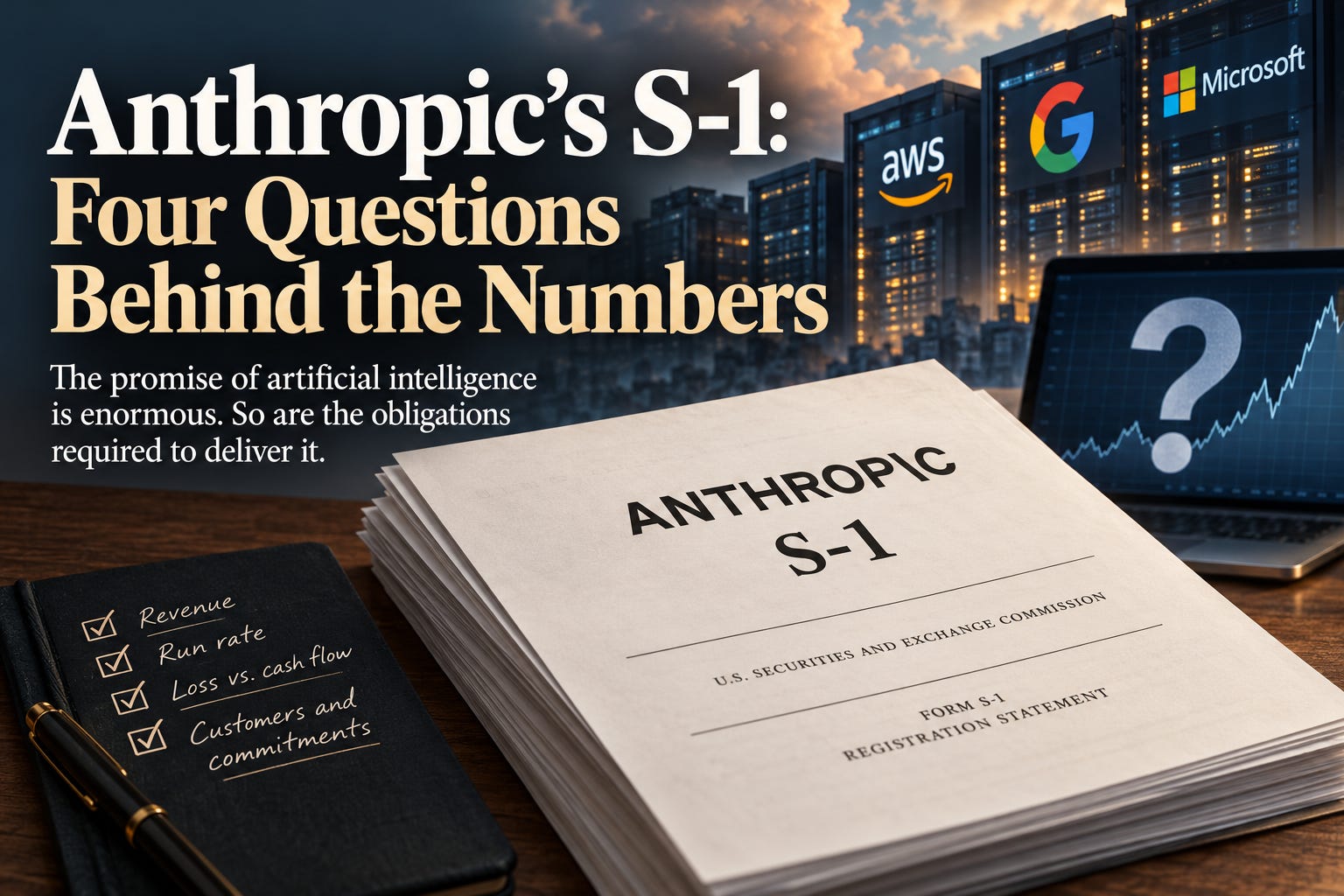
An initial public offering provides investors with something more useful than a company’s ambitions: it’s financial statements. Anthropic’s S-1 presents a business growing at remarkable speed, but its numbers require careful reading. Revenue is not necessarily money retained. An annualized sales figure is not annual revenue. An accounting loss is not the same as cash leaving the business. And contracts that secure computing capacity today can become financial burdens tomorrow. Before deciding what Anthropic might be worth, understand what the company earns, spends, owes, and risks. Four questions provide a useful starting point.
First, how much revenue does Anthropic actually keep?
When customers purchase Claude through cloud marketplaces, Anthropic reports the full amount customers pay as revenue, even though it must share some of that money with its cloud partners. It is reporting gross revenue.
In a simplified example, if a customer pays $100 and Anthropic pays $20 to a cloud provider, Anthropic still reports $100 in revenue, not $80. This accounting method makes reported revenue larger than the amount Anthropic retains after paying its partners.
Even so, the company’s reported growth has been remarkable. Revenue increased from $1.2B in the first half of last year to $16.3B in the first half of this year, an increase of more than 13X.
The important question is not simply how quickly revenue is growing, but how much of that revenue Anthropic keeps after paying the costs of delivering its services.
Second, how much revenue is Anthropic generating, and what would that amount to over a full year?
The company used run-rate revenue to estimate its annual revenue based on recent sales. It took the revenue from usage fees over the most recent 28 days and multiplied it by 13 and then added it’s monthly subscription revenue multiplied by 12. This provides a snapshot of how much Anthropic might earn in a year if its current sales continue at the same pace.
However, the company warns that this is not actual annual revenue or even a prediction of future sales. Its October run-rate figure has not yet been disclosed. What we do know is that Anthropic generated $11.6B in revenue for the second quarter. If it maintained that pace for four quarters, annual revenue would be approximately $46.2.
That is a useful comparison, but it does not tell us how much the company will actually earn over the next year. Annualizing a single quarter also produces a different measure from the company’s official run-rate calculation.
Third, how can Anthropic report an $80.7B loss while generating $3.9B in positive operating cash flow?
The answer lies largely in accounting rules.
During the first half of the year, the filing shows Anthropic recorded an $80.7B net loss. Of that amount, $72.4B came from an increase in the accounting value of financial instruments that investors can convert into company shares. So as Anthropic’s valuation increased, so did the value of these obligations, creating a large accounting loss without an immediate cash payment. Another $8.8B came primarily from similar accounting adjustments to financial agreements.
These losses do not mean Anthropic spent $80.7B dollars in cash. Its operating loss was much smaller, only $693M. Meanwhile, the company reported $3.9B in positive operating cash flow.
In other words, Anthropic’s reported net loss was driven largely by accounting adjustments, while its operating activities brought in more cash than they paid out during the period. That positive cash flow, however, does not include all spending on long-term infrastructure investments. It also does not establish that the company’s operations are profitable.
Fourth, who are Anthropic’s customers and what are their financial commitments?
On the customer side, the picture appears relatively healthy. No single customer accounted for more than 10% of revenue in the first 9 months and their 5 largest customers together accounted for approximately 25% of their revenue. This suggests Anthropic is not overly dependent on a handful of customers.
The other side of the balance is more complicated. As of June, the filing shows Anthropic had approximately $266B in fixed or minimum computing commitments, with contracts extending from 1 to 20 years. They also disclosed a five-year equipment lease requiring approximately $125B in rental payments. This lease can’t be cancelled except in the case of a default (p. 75).
The $266B in computing commitments alone is approximately 58 times the company’s previous annual revenue. These obligations are spread over many years, so the comparison does not mean Anthropic must pay that amount immediately. Nor should the two contractual totals be added together without confirming whether they overlap.
Nevertheless, the scale is extraordinary. Anthropic is committing substantial sums to computing infrastructure based on expectations of future demand. If revenue continues growing rapidly, those commitments may prove advantageous. If growth slows, the company could find itself paying for computing capacity that customers no longer need at the expected prices. The central question is whether future revenue will be sufficient to support the commitments being made today.
The unusual relationship with its largest technology partners
There are other complications. Amazon, Google, and Microsoft have made significant equity investments in Anthropic. They also have commercial relationships with the company. And at the same time, they each develop and deploy competing products. They are investors, customers, and competitors.
Such arrangements are not necessarily improper. They can provide access to capital, computing infrastructure, and customers. But they also make the company’s financial relationships difficult to evaluate.
Investors should understand how much Anthropic depends on these companies, what each receives in return, and how those relationships might change as competition intensifies.
What remains unanswered
Several important figures remain undisclosed in the version of the filing described here, including the offering price, third-quarter revenue, and the latest revenue run rate.
Those numbers will matter. So will the details behind Anthropic’s computing commitments, cash flow, and relationships with its largest technology partners.
The purpose of examining an S-1 is not to predict the offering price or declare whether the shares are attractive. It is to understand the business before the market assigns it a value.
Anthropic may become one of the defining companies of this era. But technological importance and investment returns are different things. History offers ample evidence that a company can transform an industry without rewarding those who finances the transformation.
We take no position on the offering or its price. We read what the company files, examine what the numbers mean, and identify the questions that remain.
The future may belong to AI, but so will obligations belong to the companies building it. Invest wisely, my friends.
For information only. Not investment advice. Nothing in this article is a recommendation to buy, sell or hold any security.
Sources (for the post): Anthropic S-1