

Prefer to watch? Here’s the 4-minute summary:
November 5, 2026
Wall Street has a fondness for celebrating yesterday’s earnings while quietly revising tomorrow’s expectations. Apple and AMD have given investors reasons to celebrate. Both exceeded revenue forecasts, delivered strong earnings, and demonstrated that there’s substantial demand for their products. Yet their guidance suggests an uncomfortable future: higher memory costs, constrained manufacturing capacity, and the expensive business of satisfying the artificial intelligence industry’s ambitions.
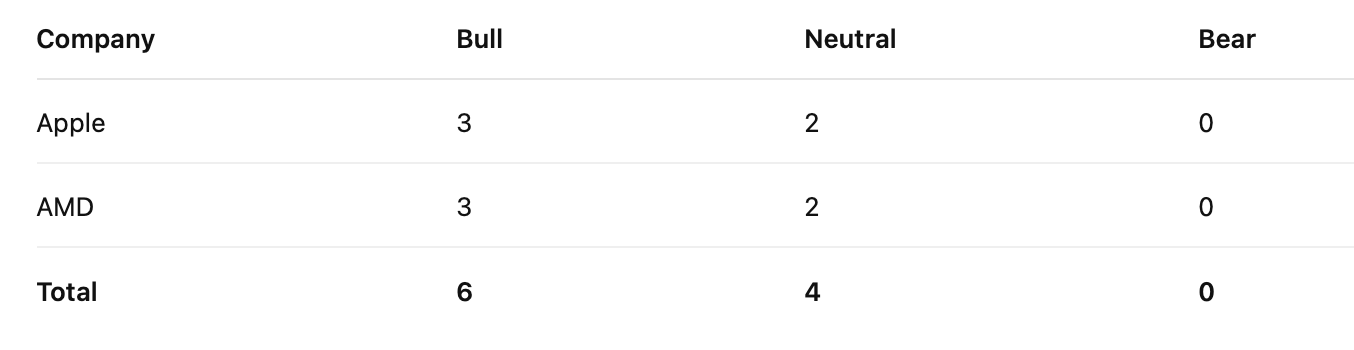
Before either company reported, we published ten financial and operational thresholds. Six earned Bull, four Neutral, and none Bear. Apple’s iPhone revenue reached a September-quarter record, and its supply kept up. AMD demonstrated that it could deliver complete AI computing systems, not merely announce them. The next test is whether either company can preserve its margins while expanding production.
How We Keep Score
Our thresholds were published November 2 and 3, before earnings. Results meeting our strong lines earn Bull; those under our weak lines earn Bear; everything between is Neutral. We grade reported results against company filings, not analyst estimates. The thresholds never change afterward.
The purpose is not to prove we can predict the future. It is to prevent ourselves from rewriting the past.
Apple: Strong Sales, Expensive Components
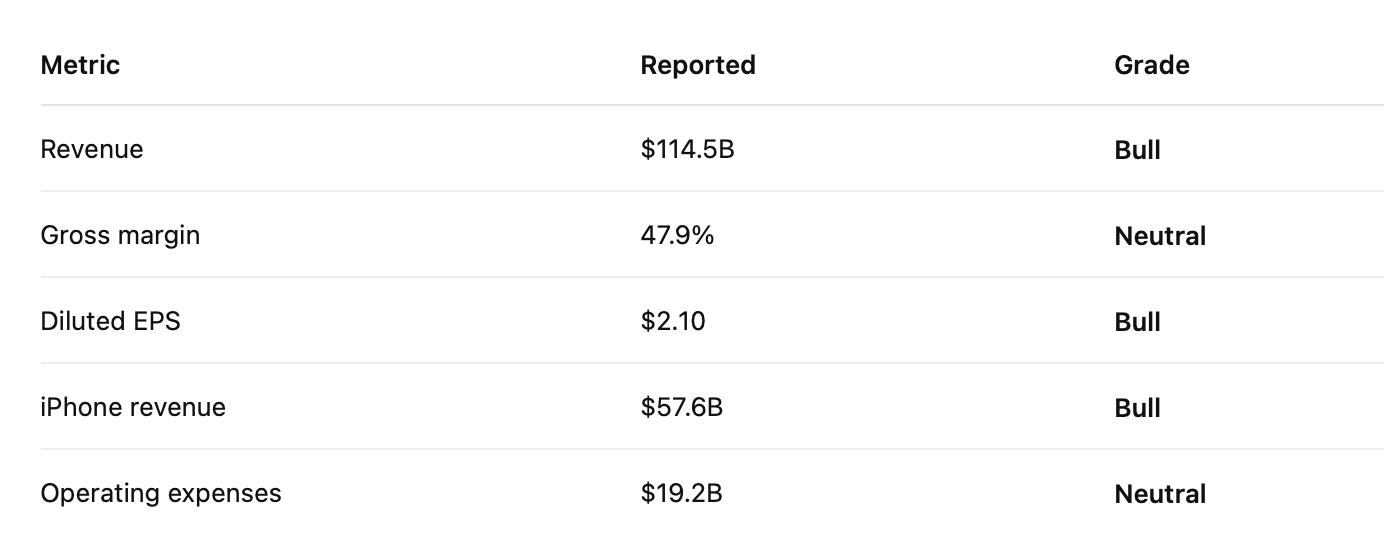
Apple’s revenue increased 12%, exceeding its $113.7 billion upper guidance limit. iPhone revenue climbed 17% to a September-quarter record, while diluted earnings rose 14%. Three strong lines cleared.
The qualifications matter. Apple’s 47.9% gross margin included approximately one percentage point from tariff refunds. Without that benefit, margin would have been roughly 46.9%, below our Bear threshold. Reported earnings also benefited by five cents per share. We grade the reported figures, not hypothetical alternatives, but investors should understand what produced them.
New CEO John Ternus inherits an awkward combination: enthusiastic customers and expensive components. Apple’s December-quarter guidance calls for revenue growth of 7%–10%, but gross margin falls to 45%–46%, reflecting higher memory costs and spending associated with Siri AI.
The demand is there, the question is profitability.
Apple: Three Bulls, two Neutrals.
AMD: The AI Factory Leaves the Loading Dock
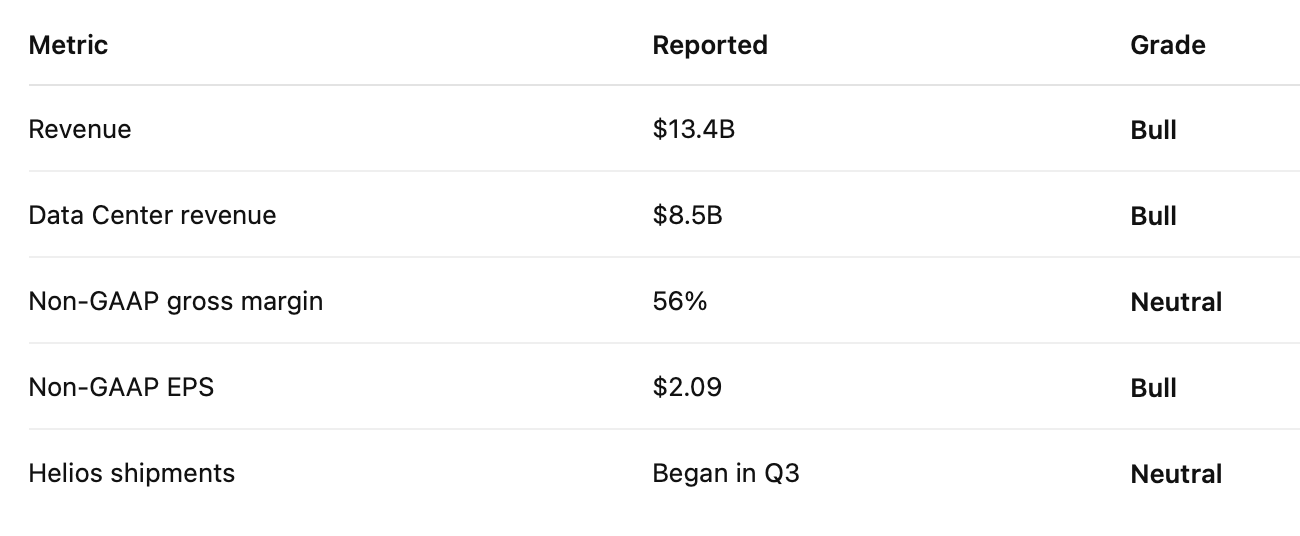
AMD’s revenue surged 45%, exceeding its upper guidance limit by $77 million. Data Center revenue nearly doubled, rising 97%, while adjusted earnings increased 74%. Three more Bulls.
But the most consequential development was operational. AMD confirmed that its first Helios rack-scale AI systems shipped for revenue during the third quarter. That fulfilled management’s August commitment. Because shipments began on schedule rather than ahead of it, our grade is Neutral.
This distinction matters. A customer announcement is not a shipment, and a shipment is not necessarily a profitable business. AMD is moving from selling processors toward supplying complete AI computing systems. The opportunity is larger, but so are the engineering and integration costs.
AMD’s fourth-quarter guidance calls for approximately $17 billion in revenue, up about 27% sequentially. Yet expected non-GAAP gross margin declines from 56% to approximately 55%.
The AI factory is leaving the loading dock. Its profitability remains under examination.
AMD: Three Bulls, two Neutrals.
The Scorecard
What Comes Next
Apple and AMD share a problem that prosperity has not solved: the cost of producing what customers want. Apple’s memory expenses are rising. AMD’s fastest-growing business carries margins below its company average. Both companies expect strong revenue growth alongside lower gross margins.
The distinction between growth and profitability is becoming more important as AI infrastructure spending accelerates. Investors may celebrate record sales, but shareholders ultimately own earnings, not shipments.
Ten thresholds. Six Bulls. Four Neutrals. No Bears. The eight Bears already on our running record remain there.
Thresholds first. Grades later. Misses included.
Subscribe to Portfolio Lens Research for our next scorecard.
Sources: Apple Q4 fiscal 2026 earnings release (8-K Ex. 99.1, Nov 2, 2026) · AMD Q3 2026 earnings release (8-K Ex. 99.1, Nov 3, 2026) · Apple Q4 fiscal 2026 earnings call (Nov 2) · AMD Q3 2026 earnings call (Nov 3) · Apple Q1 fiscal 2026 earnings release (8-K Ex. 99.1), for last December’s revenue
For informational purposes only. Not investment advice.