

If you’d to view the 3:12 minute summary:
November 2, 2026
There is a peculiar indignity in being the world’s most valuable consumer electronics company and discovering that the obstacle to selling more products is the inability to make them. Apple has spent decades perfecting the art of persuading customers to buy expensive devices. Now it confronts a more elementary problem: obtaining enough components to manufacture them.In July, Apple reported that iPhone revenue had surged 22%, Mac revenue had risen 29%, and total sales had increased 16% to $109.4 billion. Yet Apple guided the following quarter to growth of just 9% to 11%. The culprit was not a shortage of customers. It was a shortage of chips.
Tim Cook described the company’s supply difficulties with unusual candor, warning that Apple would be “scrambling on the supply side.” He called soaring memory prices a “100-year flood.” Neither problem is unique to Apple. Artificial intelligence is competing for semiconductor manufacturing capacity, while memory costs are rising across the technology industry. The consequences reach well beyond Silicon Valley: when essential components become scarce, even the most powerful companies must choose between higher prices, lower margins, and fewer products to sell. Apple’s earnings on Monday will offer an unusually revealing examination of those choices.
Four Tests Before the Results
Apple reports fiscal fourth-quarter earnings Monday after the market closes, followed by its conference call at 2:00 p.m. Pacific.
We are publishing five lines before the results arrive.
A result the same as or better than our strong line earns Bull. A result worse than our weak line earns Bear. Everything between is Neutral. The lines will not change after Apple reports.
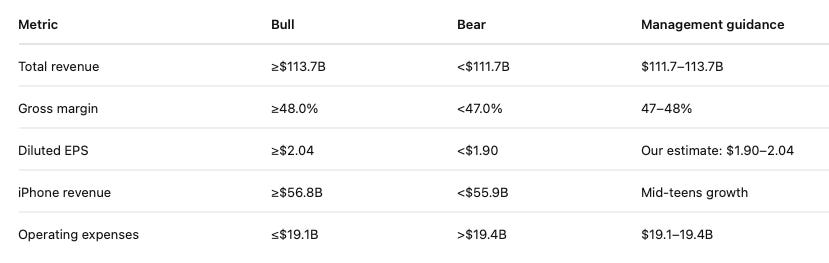
Two additional measures will be tracked, not graded: Apple’s installed base of active devices, currently above 2.5 billion, and its guidance for the December holiday quarter. These figures provide important context without introducing new grading criteria after the fact.
Test One: Can Apple Ship Enough iPhones?
Apple’s June-quarter iPhone revenue reached $54.3 billion, up 22%. However, management warned that supply constraints affecting iPhone, Mac, and iPad would increase significantly in the September quarter. For comparison, iPhone revenue was $49.0 billion in the year-earlier quarter. Our lines are straightforward:
Bull: At least $56.8 billion, approximately 16% growth.
Bear: Below $55.9 billion, approximately 14% growth.
The difference between these outcomes is not necessarily consumer enthusiasm. It may well be manufacturing capacity. Strong demand means little to quarterly revenue if the products cannot reach customers.
Test Two: Can Apple Protect Its Margins?
Apple’s third-quarter gross margin reached 50.1%, helped by approximately two percentage points of tariff refunds. For the fourth quarter, CFO Kevan Parekh guided to 47%–48%, including roughly one percentage point of tariff refunds. The decline reflects a difficult cost environment. Memory prices have risen sharply. Cook warned that previously purchased, lower-cost inventory would provide less protection after September. Apple is responding through lower costs on other components and price increases on iPad and Mac products.
Our bull line is 48% gross margin. Anything below 47% is a Bear.
The important question is not whether costs increased. Management has already acknowledged that. It’s whether Apple’s pricing power and supply-chain discipline can offset those costs.
Test Three: Can Earnings Outrun Expenses?
Apple guided quarterly operating expenses to between $19.1B and $19.4B. We will grade expenses separately from earnings per share. Our Bull lines are:
Diluted EPS: At least $2.04.
Operating expenses: No more than $19.1 billion.
Our Bear lines are EPS below $1.90 or operating expenses above $19.4 billion. The EPS thresholds are our estimates derived from management’s guidance, not an official Apple EPS forecast. This distinction matters. Apple can deliver strong revenue while disappointing investors if higher component costs and operating expenses absorb too much of the benefit. Revenue is an achievement. Profit is the accounting.
Test Four: What Does New Leadership Say About December?
This is Apple’s first earnings report under CEO John Ternus, who succeeded Tim Cook on September 1. Cook now serves as Executive Chair. The September quarter largely reflects decisions made before the transition. The December-quarter outlook will be more revealing.
Holiday demand traditionally makes this Apple’s most important selling season. Management’s guidance should indicate whether advanced-chip shortages are easing, memory costs are stabilizing, and production can support expected demand. We will track that guidance without assigning a grade. One quarter cannot establish a new CEO’s record. But it can reveal the problems he has inherited.
What Apple Tells Us About the Economy
Apple’s earnings will offer a useful perspective on the competition for semiconductor capacity. Memory chips serve both consumer electronics and AI infrastructure. Advanced manufacturing capacity is similarly contested. When supply cannot satisfy demand, prices rise. Those costs eventually reach shareholders through lower margins or customers through higher prices.
Apple possesses unusual advantages: purchasing scale, brand loyalty, pricing power, and an installed base exceeding 2.5 billion active devices. Yet even Apple cannot negotiate away the laws of supply and demand. The question Monday is whether its advantages are sufficient to protect growth and profitability while the technology industry’s infrastructure requirements expand.
Apple has demonstrated that it can create demand. Monday will show how much of that demand it could actually satisfy.
We will grade these five measures on Thursday, November 5, along with AMD. The original thresholds will remain available for readers to compare with Apple’s reported results.
The purpose of scorecards is not to prove that we can see the future. It is to prevent ourselves from rewriting the past.
Lines first. Grades later. Misses included.
Subscribe to Portfolio Lens Research to receive the results.
Sources
Apple fiscal Q3 2026 earnings release, July 30, 2026 (Form 8-K, Exhibit 99.1).
Apple fiscal Q3 2026 earnings conference call, July 30, 2026.
Apple fiscal Q4 2025 earnings release, October 30, 2025.
Apple Form 8-K regarding CEO transition, April 20, 2026.
For informational purposes only. Not investment advice. Nothing in this article constitutes a recommendation to buy, sell, or hold any security.