

The Price of Progress
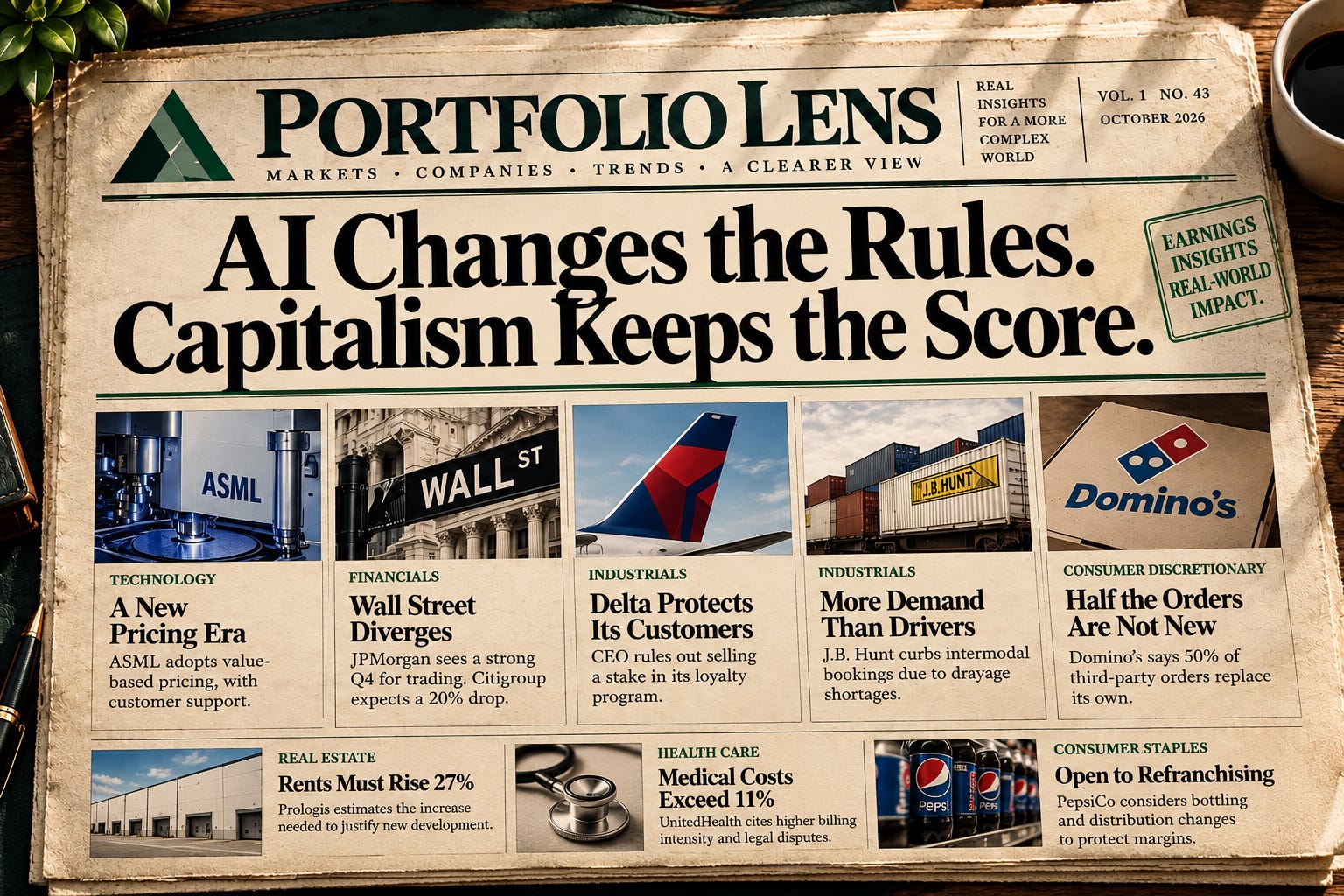
Capitalism has an enduring talent for rearranging the balance of power, usually when its participants have grown comfortable with the existing arrangement. For decades, semiconductor equipment manufacturers negotiated prices according to established commercial practices. Now ASML, whose machines make the most advanced chips possible, has discovered that artificial intelligence offers an opportunity to reconsider those arrangements. Its customers, apparently persuaded that the economic value of computing has changed, are accepting a different approach to pricing. Elsewhere, Delta Air Lines refuses to place financial investors between itself and its most loyal passengers, while Domino’s discovers that half the orders arriving through outside delivery platforms may simply be orders diverted from its own channels. The common thread is unmistakable: technology creates wealth, but the more consequential question is who gets to keep it.
The week’s corporate reports also reveal an economy struggling with constraints that conventional measures often overlook. J.B. Hunt has more potential freight business than its drivers can accommodate. Prologis finds that new warehouses require rents 27% above current market levels to justify construction. UnitedHealth faces medical costs rising faster than expected, driven partly by billing practices and regulatory disputes rather than clinical demand alone. Even Wall Street cannot agree on its immediate prospects: JPMorgan anticipates unusually resilient trading activity, while Citigroup expects the customary fourth-quarter retreat. These contradictions suggest that the American economy is neither uniformly strong nor uniformly weak. It is undergoing a redistribution of costs, opportunities and bargaining power. The companies that prosper will not necessarily be those that produce the most, but those that best understand where value is moving—and how to retain their share of it.
What We Heard
Technology | ASML Changes Its Pricing Model
ASML (ASML) is introducing value-based pricing after decades of established pricing practices. CEO Christophe Fouquet said customers recognize that AI is changing how value is distributed across the semiconductor industry.
The company expects no pricing impact in 2026. The changes could support margins in subsequent years, particularly as new equipment generations enter production.
The important development is not simply higher prices. It is customers’ willingness to acknowledge ASML’s growing importance to their own profitability.
Source: Christophe Fouquet, CEO, FY2026 Q3 earnings call.
Financials | Wall Street Disagrees About the Fourth Quarter
JPMorgan (JPM) expects trading activity to remain unusually strong despite the normal seasonal slowdown. CEO Jamie Dimon cited global uncertainty and market volatility.
Citigroup (C) expects a more conventional fourth quarter, with trading revenue declining approximately 20% sequentially.
The difference matters because trading revenue can materially affect investment bank earnings. Continued volatility would favor JPMorgan’s outlook. A return to normal seasonal patterns would support Citigroup’s expectations.
Sources: JPMorgan CEO Jamie Dimon and Citigroup CFO Gonzalo Luchetti, FY2026 Q3 earnings calls.
Industrials | Delta Refuses to Sell Its Customer Relationships
Delta Air Lines (DAL) will not sell a stake in or borrow against its loyalty program.
CEO Ed Bastian believes that financial investors could weaken Delta’s direct relationships with valuable customers. He also warned that AI booking agents could become the next generation of online travel intermediaries, making airline products easier to compare and harder to differentiate.
Delta is protecting something that may become increasingly valuable: the customer’s preference for a particular company.
Source: Ed Bastian, CEO, FY2026 Q3 earnings call.
Industrials | J.B. Hunt Has More Demand Than Capacity
J.B. Hunt (JBHT) reported 8% intermodal volume growth but said it could have handled more business.
A shortage of drayage drivers limited the company’s ability to move containers between rail terminals and customers. This occurred despite favorable pricing for rail transportation relative to trucking.
The constraint was operational capacity, not simply customer demand.
Additional drivers could unlock volume that the company could not accommodate during the quarter.
Source: Darren Field, President of Intermodal, FY2026 Q3 earnings call.
Consumer Discretionary | Domino’s Discovers the Cost of Convenience
Domino’s Pizza (DPZ) estimates that approximately 50% of orders through third-party delivery platforms replace orders customers otherwise would have placed directly.
The other half represents incremental business.
This distinction matters because outside platforms charge fees and control important parts of the customer relationship.
Domino’s must balance the benefits of reaching new customers against the cost of shifting existing customers away from its own ordering channels.
Source: Joseph Hugh Jordan, CEO, FY2026 Q3 earnings call.
Real Estate | Prologis Sees a Coming Warehouse Shortage
Prologis (PLD) estimates that market rents must increase 27% before new warehouse construction becomes financially attractive.
This gap helps explain why industrial construction starts have fallen to unusually low levels.
If demand accelerates while construction remains limited, available warehouse space could tighten and rents could rise.
However, slower tenant demand could delay that outcome.
Source: Dan Letter, CEO, FY2026 Q3 earnings call.
Health Care | UnitedHealth Faces Rising Medical Costs
UnitedHealth (UNH) reported commercial medical cost trends exceeding its initial 11% expectation.
Management identified three contributors: higher clinician billing intensity, costs associated with the No Surprises Act, and expensive specialty medications.
These pressures can increase insurance claims expenses even without a comparable increase in patient visits.
Persistent cost growth could reduce insurance profitability and increase pressure on future premiums.
Source: Tim Noel, FY2026 Q3 earnings call.
Consumer Staples | PepsiCo Considers a Different Distribution Model
PepsiCo (PEP) is considering transferring selected U.S. bottling and distribution operations to independent partners.
CEO Ramon Laguarta said management is evaluating opportunities to reduce costs and improve long-term performance.
Refranchising could reduce PepsiCo’s capital requirements and operating expenses, moving parts of its business closer to Coca-Cola’s distribution model.
However, management has not committed to a broad restructuring.
Source: Ramon Laguarta, Chairman and CEO, FY2026 Q3 earnings call.
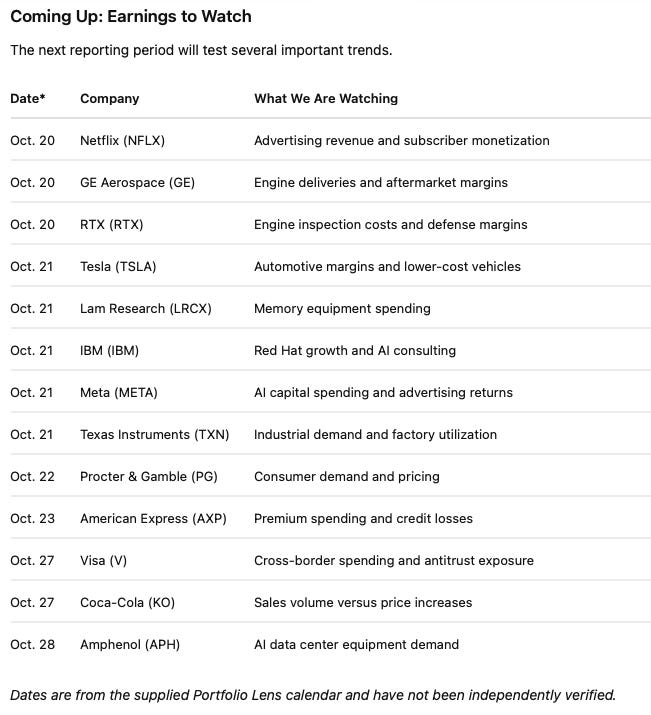
The Portfolio Lens Perspective
Three themes connect this week’s findings.
First, control of the customer is becoming more valuable. Delta and Domino’s recognize that intermediaries can generate sales while weakening direct customer relationships.
Second, scarcity is changing bargaining power. ASML can reconsider pricing because its equipment is essential. Prologis sees future pricing opportunities because new warehouse construction is economically difficult.
Third, strong demand does not guarantee strong results. J.B. Hunt lacks sufficient operating capacity, while UnitedHealth faces costs that exceed its earlier expectations.
The lesson is familiar, although technology gives it new urgency: Economic value belongs not merely to those who create it, but to those with sufficient leverage to retain it.
Portfolio Lens reviewed 35 earnings calls between October 3 and October 17, 2026. The observations above are attributed to the companies’ FY2026 Q3 earnings calls. Individual transcript URLs were not included in the supplied material; these source references identify the speakers and calls but are not direct verification links.
Portfolio Lens examines earnings calls, management commitments and SEC filings to identify changes in corporate performance and strategy.
Explore our research at getportfoliolens.com.
For information only. Not investment advice.