

Prefer to watch? Here's the 2-minute summary:
Wednesday, November 11, 2026
Every industrial revolution produces fortunes, although not always for the people doing the most work. Railroads transformed America while bankrupting many railroad companies. The internet transformed commerce while leaving a remarkable collection of expensive failures. Artificial intelligence promises another transformation, accompanied by an equally familiar question: Who captures the profits? Cisco (CSCO) and Applied Materials (AMAT) occupy two indispensable positions in this new economy. Cisco connects the computers. Applied supplies the machinery that makes their chips. Both are benefiting from extraordinary demand. Whether that demand produces extraordinary returns is another matter.
The distinction is increasingly important. AI data centers require more networking equipment, more sophisticated semiconductors and more expensive infrastructure. Cisco’s revenue is accelerating, but its margins have narrowed as hardware and memory costs rise. Applied’s revenue and margins have moved in the more agreeable direction, although its expansion requires substantial investment. Both report Thursday, November 12, after the market closes. Before the results arrive, Portfolio Lens has established 14 financial tests. The object is not to predict the future with theatrical confidence. It is to prevent the past from being rewritten once the numbers become inconvenient.
How We Keep Score
We published these thresholds on November 4, before either company reported. Results at or beyond the strong line earn Bull. Results at or beyond the weak line earn Bear. Everything between earns Neutral. For expenses, lower is better. We grade against company disclosures rather than analyst estimates and never move the thresholds afterward. The purpose of scorecards is not to prove that we can see the future. It is to prevent ourselves from rewriting the past.
Cisco: More Revenue, Less Margin
Cisco’s July-quarter revenue rose 18% to $17.3 billion, exceeding management’s guidance. Large cloud customers placed $4 billion in AI infrastructure orders during the quarter and $9.3 billion during the fiscal year. Cisco expects AI infrastructure revenue to rise from approximately $4 billion last year to $7.5 billion this year.
But growth carries a price. Non-GAAP gross margin fell from 68.4% to 66.3%, reflecting a greater proportion of hardware sales and higher memory costs. Management’s current guidance of 65–66% suggests further pressure despite approximately 21% expected revenue growth.
Cisco’s seven thresholds
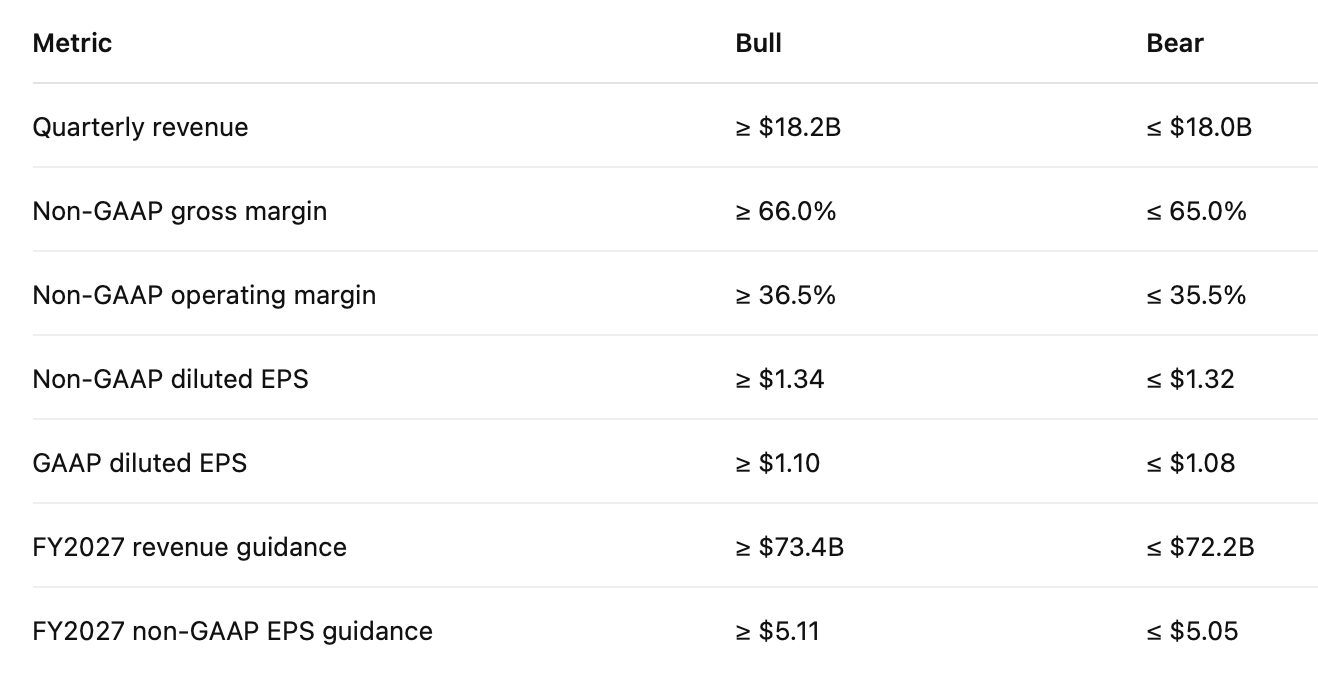
For full-year guidance, we grade the midpoint of the updated range. Reaffirming existing guidance earns Neutral. Beyond the thresholds, enterprise orders deserve attention. They rose 21% last quarter, while campus networking grew 20%. Security revenue increased 14%, helped by Splunk, although Cisco does not disclose Splunk revenue separately.
The question is whether AI infrastructure and recurring software revenue can offset weaker hardware economics. Selling more equipment is admirable. Keeping more profit from each sale is preferable.
Applied Materials: Selling the Tools of the Revolution
Applied Materials occupies an enviable position. AI companies compete to develop better chips, but virtually every advanced semiconductor requires increasingly sophisticated manufacturing equipment. Applied’s third-quarter revenue reached a record $9.12 billion. Its fourth-quarter guidance midpoint of $10.25 billion implies approximately 51% annual growth and 12% sequential growth.
Unlike Cisco, Applied has expanded its margins. Gross margin has improved year over year for 13 consecutive quarters. CEO Gary Dickerson expects leading-edge foundry and logic, DRAM and advanced packaging to account for approximately 80% of semiconductor equipment spending growth during 2026 and 2027.
Applied Materials’ seven thresholds
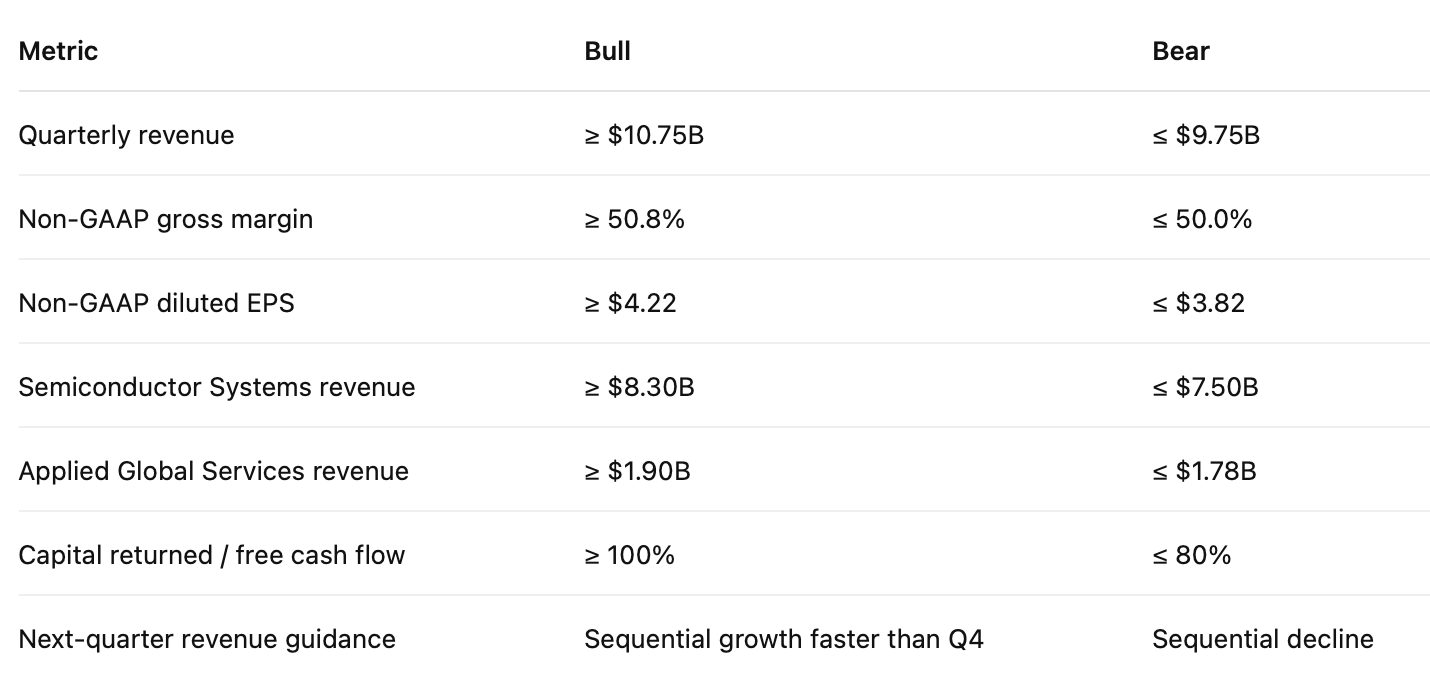
Everything between grades Neutral. The next quarter contains 14 weeks rather than 13, a calendar advantage worth remembering.
Applied’s geographic exposure also matters. China represented 28% of revenue last quarter, down from 35% a year earlier. Management expects growth in Chinese demand for mature-node manufacturing equipment. Capital allocation provides another test. Applied targets returning 80–100% of free cash flow to shareholders. Last quarter it returned $860 million, approximately 37% of free cash flow.
Growth may be impressive, but shareholders are entitled to ask when the cash comes home.
The Difference Between a Boom and a Treadmill
Cisco and Applied illustrate two possible outcomes of the AI infrastructure expansion. Both are selling more. Only Applied has consistently demonstrated improving gross margins. Cisco’s challenge is rising component costs and a heavier hardware mix. Applied’s is sustaining profitability while expanding manufacturing capacity, including a $500 million Singapore facility and more than 1,000 additional customer support engineers.
Thursday’s reports will help distinguish companies benefiting from the boom from those merely running faster to serve it.
Revenue measures the size of the opportunity. Margins reveal who gets to keep the money.
We will grade all 14 thresholds in our next scorecard.
Thresholds first. Grades later. Misses included.
Subscribe free to Portfolio Lens Research to receive the scorecard.
Sources: Cisco fiscal Q4 2026 earnings release and prepared remarks (August 12, 2026); Cisco fiscal Q1 2026 earnings release (November 12, 2025); Applied Materials fiscal Q3 2026 earnings release and conference call (August 13, 2026); Applied Materials fiscal Q4 2025 earnings release (November 13, 2025); company earnings announcements.
Not investment advice. Research for informational purposes only. Investing involves risk, including loss of principal. Past performance does not indicate future results.