

Prefer to watch? Here’s the 2-minute summary:
Tuesday, November 10, 2026
Wall Street has discovered something remarkable about artificial intelligence: the machines may be intelligent, but the financing arrangements are decidedly old-fashioned. Someone must borrow money, purchase expensive equipment, construct enormous buildings and hope the customers keep paying. CoreWeave (CRWV) has become an uncomfortable illustration. Its shares and bonds came under pressure in October as investors questioned the debt supporting its expansion. Moody’s estimated adjusted leverage of 11.4 times following financing completed earlier this year. Management argues that its enormous contract backlog supports its obligations. Investors are asking a less fashionable question: What happens when borrowing costs, equipment depreciation and customer commitments do not cooperate? The AI revolution may transform civilization. It has not yet persuaded creditors to abandon arithmetic.
Nebius (NBIS) faces a similar examination, although its financial architecture differs. Where CoreWeave has relied heavily on borrowing secured by computing equipment and customer contracts, Nebius has emphasized customer prepayments, convertible notes and equity. That distinction matters, but it does not make the companies independent of one another’s fortunes. Both depend on expensive NVIDIA systems, enormous capital commitments and customers willing to rent computing power at attractive prices. A loss of confidence in one company’s financing can make investors question the economics of the entire industry. CoreWeave reports Tuesday after the close; Nebius reports Thursday morning. Together, they offer an unusually revealing examination of what happens when technological ambition encounters the cost of capital.
Two Companies, Two Balance Sheets
Both companies purchase NVIDIA computing systems, install them in data centers and rent their processing capacity to AI developers and enterprises. Their second-quarter results reveal extraordinary growth—and equally extraordinary capital requirements.
Second Quarter 2026: Side by Side
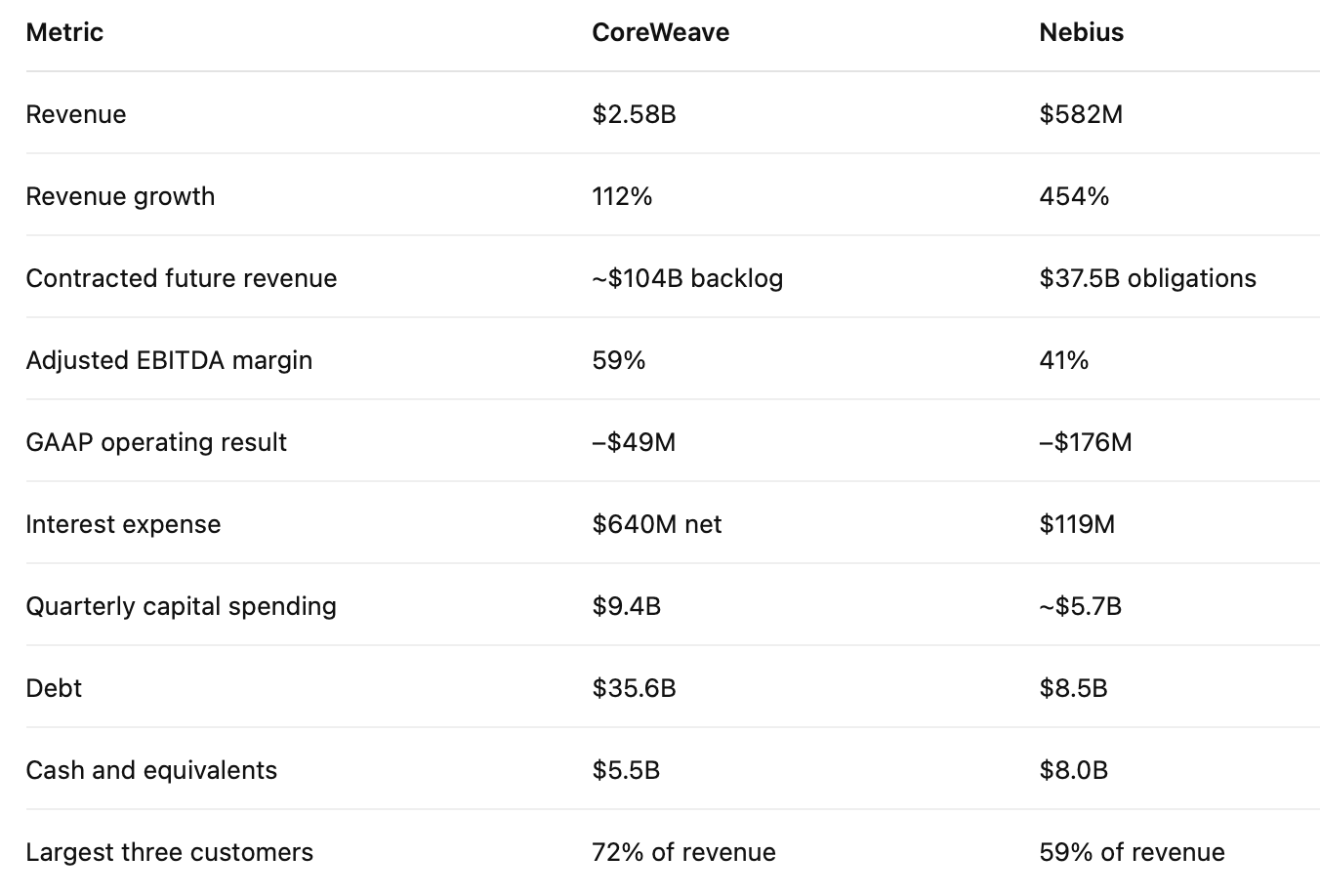
Source: Company second-quarter releases, filings and earnings calls. Contracted revenue definitions differ. Nebius’s interest expense includes interest recognized on customer advances.
By revenue, CoreWeave is more than four times the size of Nebius. Its debt is also more than four times as large. Both companies depend heavily on a small number of customers. Large contracts provide visibility, but concentration creates risk when a customer’s plans change. The distinction between contracted revenue and collected cash deserves particular attention. A backlog is a promise of future business, not money already deposited in the bank.
The Price of a Megawatt
AI cloud providers measure capacity in electricity because computing infrastructure ultimately consumes power. CoreWeave reported 1.5 gigawatts of active capacity and 4.2 gigawatts contracted as of August 11. Nebius targeted five gigawatts contracted and 0.8–1 gigawatt connected by year-end. Both have disclosed contract pricing that suggests substantial revenue potential.
In September, CoreWeave said certain short-term contracts were priced at approximately $40 million in annualized revenue per megawatt. Nebius reported $20–25 million per megawatt on its four largest second-quarter deals, while identifying opportunities approaching $40–50 million on shorter contracts. These figures are not directly comparable across contract terms and configurations. Neither company provides a complete, standardized cost per installed megawatt.
The economic question is straightforward: How much revenue can each megawatt generate after paying for processors, electricity, facilities, maintenance and financing?
Who Finances the Future?
CoreWeave has financed much of its expansion through borrowing secured by GPUs and customer contracts. Its 2026 financing includes three delayed-draw facilities totaling $14.2 billion, unsecured bonds carrying coupons of 8.5%–9.75% and $8.2 billion in convertible notes. The company also received $3 billion in equity investment from NVIDIA and Jane Street. Its third-quarter guidance illustrates the financial burden: $860–940 million in net interest expense, compared with $200–260 million in adjusted operating income. Those measures are not directly interchangeable, but their relative size is instructive.
Nebius has emphasized a different combination of funding sources. Management expects more than $9 billion in customer prepayments during 2026. Approximately 70% of second-quarter deals included prepayments covering 50–60% of associated capital spending. The company also raised $10.1 billion through convertible notes, received a $2 billion investment from NVIDIA and sold approximately $2.8 billion in shares. Convertible debt generally carries lower cash interest costs because investors receive the option to convert into equity. Existing shareholders may eventually pay through dilution instead.
The financing methods differ. The fundamental obligation does not: expensive infrastructure must eventually earn more than it costs.
Ten Tests Before the Results
At Portfolio Lens, we establish Bull and Bear thresholds before companies report. A result at or beyond the strong line earns Bull. A result at or beyond the weak line earns Bear. Everything between earns Neutral. For expenses, lower is better. We grade against company disclosures, not analyst estimates and never move the thresholds afterward. The purpose of scorecards is not to prove that we can see the future. It is to prevent ourselves from rewriting the past. These lines were established November 7, before either company reported.
CoreWeave — Reports Tuesday, November 10
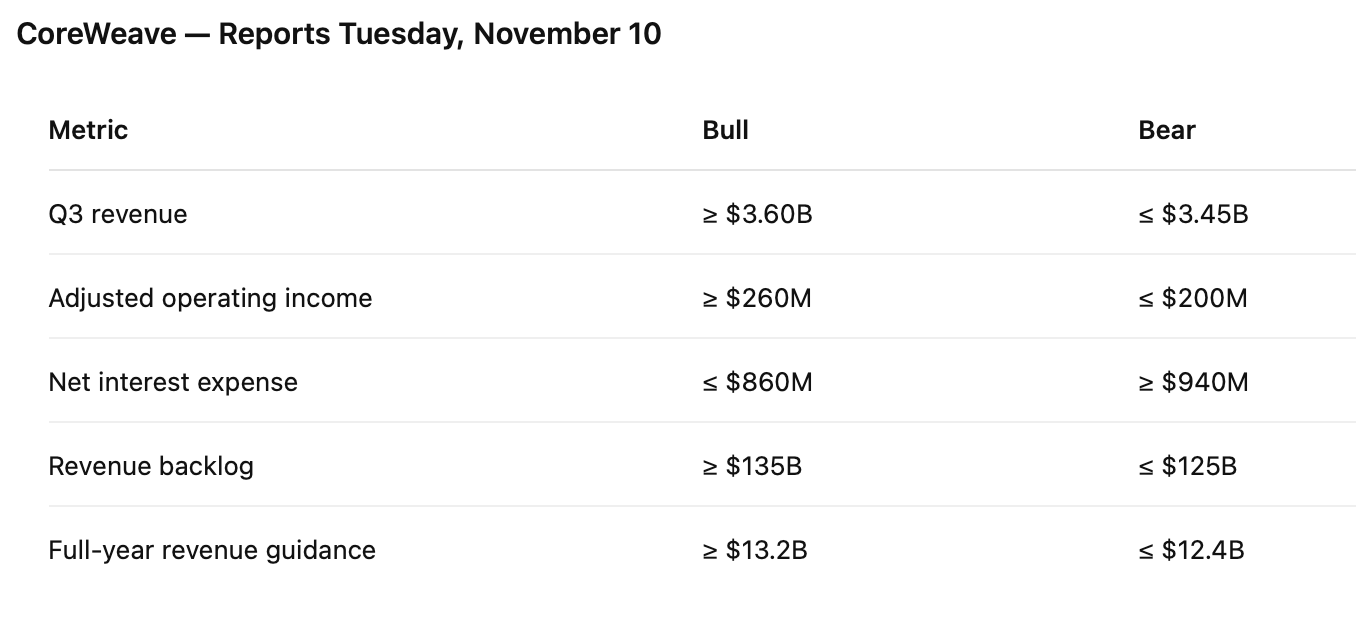
The first three thresholds reflect management’s quarterly guidance. The backlog thresholds incorporate June’s approximately $104 billion, more than $25 billion in additional contracts announced early in the third quarter and an allowance for revenue recognized during the period. For full-year guidance, we grade the midpoint of the updated range. An unchanged $12.4–13.2 billion outlook earns Neutral. What matters most: Revenue growth must translate into operating income sufficient to support the company’s expanding financial obligations.
Nebius — Reports Thursday, November 12
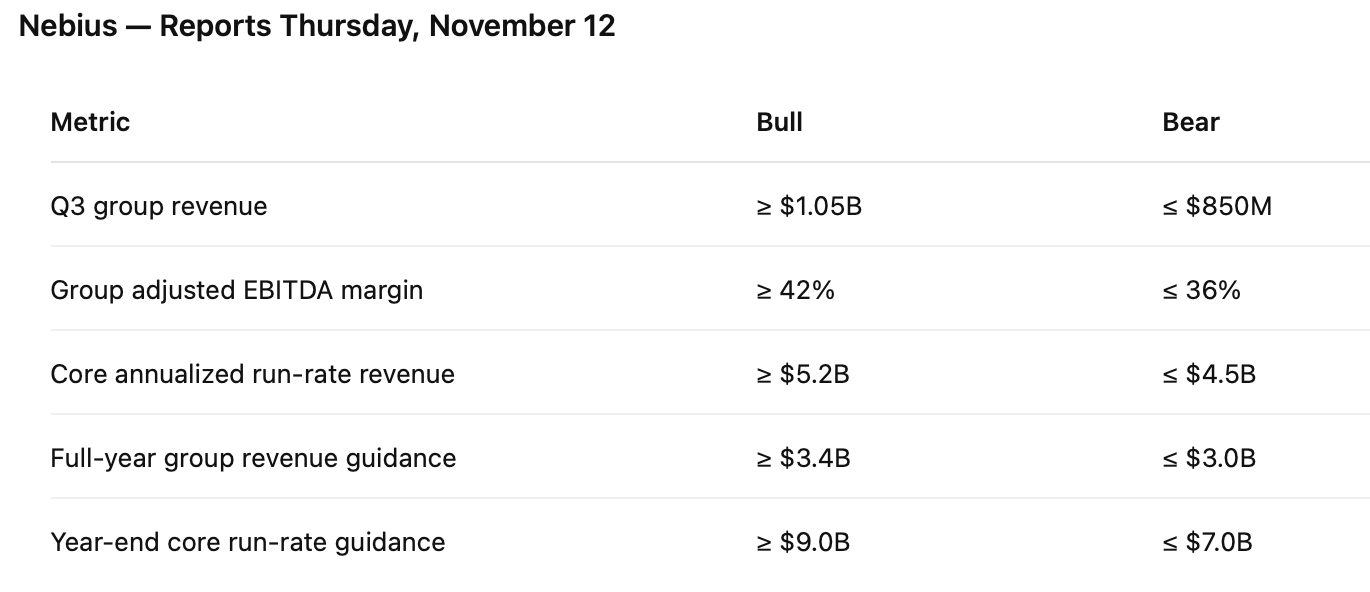
Nebius does not provide quarterly revenue guidance. Our thresholds reflect its full-year outlook, second-quarter performance and expected expansion. Core annualized run-rate revenue is September AI cloud revenue multiplied by twelve. It measures the pace of business at quarter-end, not revenue earned during the entire year. We grade updated full-year guidance using the midpoint of the disclosed range. If management reaffirms the current range, the line earns Neutral. If it provides no figure, the line remains ungraded. What matters most: Can rapid expansion produce stronger operating margins without requiring proportionately greater financing?
What We Track Beyond the Scorecard
Some disclosures deserve attention without becoming graded thresholds. For CoreWeave, we will track capital spending against its $35–39 billion annual outlook, active power capacity, outstanding debt and additional equity issuance. For Nebius, we will examine capital spending against its $20–25 billion annual plan, customer prepayments, interest expense and potential shareholder dilution.
Both companies have ambitious year-end targets. CoreWeave expects annualized revenue of $18.5–19.5 billion exiting 2026. Nebius targets $7–9 billion in core annualized run-rate revenue. These are measures of operating scale, not guarantees of profitability.
What the Results Will Tell Us
The market has spent considerable time debating which companies will dominate artificial intelligence. A more immediate question is which companies can finance the infrastructure without surrendering too much of the economic benefit to lenders, equipment suppliers and new shareholders. CoreWeave offers greater scale and a much larger contracted backlog. Nebius offers rapid growth and a financing strategy built more heavily around customer commitments and equity-linked capital.
Neither approach eliminates the risks of concentrated customers, expensive hardware, or changing demand. The earnings reports will provide another measurement of whether the economics are improving. We will grade both companies against these ten published thresholds in Friday’s scorecard. The future may run on artificial intelligence. For now, it still runs on borrowed money, customer deposits electricity.
Thresholds first. Grades later. Misses included.
Subscribe to Portfolio Lens Research to receive the scorecard when it lands.
Sources: CoreWeave Q2 2026 earnings release, Form 10-Q, August 11 earnings call and 2026 financing disclosures; Nebius Q2 2026 shareholder letter, interim financial statements, August 12 earnings call and 2026 financing disclosures.
Additional background for introduction: Reuters, October 15, 2026; Moody’s Ratings, June 11, 2026; William Blair, Rise of the Neoclouds, October 2026.
Not investment advice. Research for informational purposes only. Investing involves risk, including loss of principal. Past performance does not indicate future results.
A 17 per cent yield is not a growth company's cost of capital. It is the price lenders put on a borrower they are no longer sure gets repaid in full.