

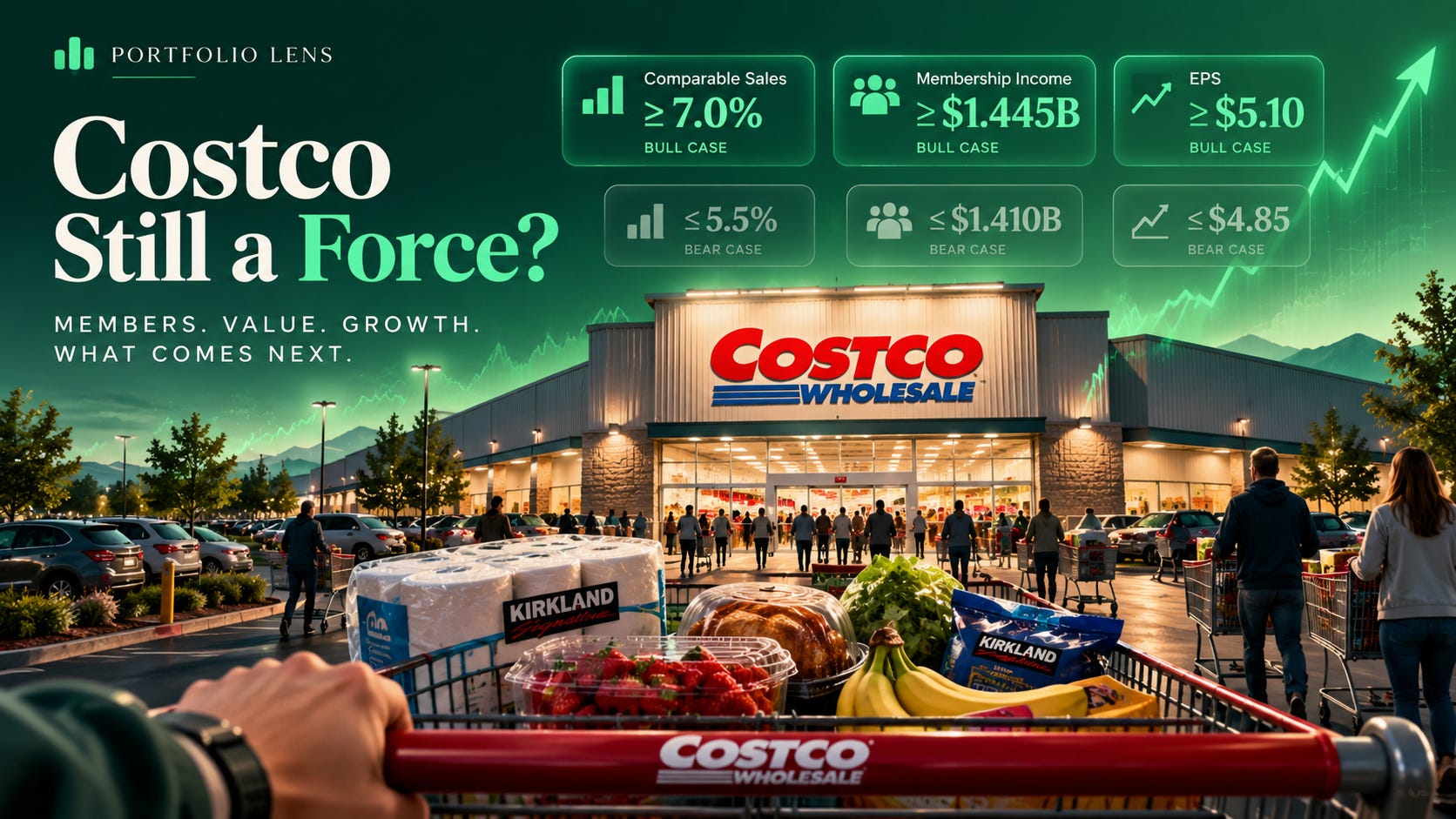
Costco’s filing presents a useful test of whether one of America’s most durable retail machines can continue defying the gravitational pull that eventually visits successful enterprises. The bull case requires comparable sales growth of at least 7%, revenue exceeding $73 billion, membership fee income above $1.445 billion and diluted earnings of $5.10 or better. Such results would suggest that Costco’s familiar virtues—traffic, customer loyalty and the increasingly valuable annuity of membership—remain formidable. Tariff refunds provide an unusual additional advantage: management is recycling much of the proceeds into lower prices, potentially converting a temporary windfall into market-share gains. A renewal rate above 90%, continued migration toward Executive memberships and progress toward 33 warehouse openings would reinforce the proposition that Costco is not merely getting larger; its economic moat is getting wider. The bear case is the inverse: comparable sales below 5.5%, revenue under $71 billion, membership income below $1.410 billion, renewal rates slipping beneath 89.7% and EPS of $4.85 or less would suggest that even Costco is encountering the limits imposed by slower organic membership growth and an increasingly expensive expansion program.
This quarter is unusually revealing because several helpful disguises are being removed at once. For the first time in two years, Costco will completely lap the September 2024 membership-fee increase, allowing investors to see how quickly the membership engine runs without a price increase pushing it downhill. Meanwhile, the company is reinvesting substantial tariff recoveries into lower merchandise prices, creating a real-world experiment in whether surrendered margin can purchase additional traffic and market share. And Costco is simultaneously embarking on a roughly $7.5 billion capital program, including 33 planned warehouse openings, even as its filings acknowledge that new stores initially dilute profitability, cannibalize existing locations and that digital businesses carry lower margins than traditional warehouses. Therein lies the interesting tension: Costco has rarely lacked opportunities to grow; the question now is whether the incremental dollar of growth remains as valuable as the one that preceded it. For a company whose extraordinary success has made excellence seem almost routine, Q1 will help determine whether today’s investments are extending the franchise—or merely making an already enormous one larger.
Bull Case
Comparable sales growth (adjusted for gasoline prices and foreign exchange): at or above 7.0% for the 12-week period of Q1 FY2027, driven by strong traffic and market share gains from tariff refund price reinvestments [transcript:FY2026-Q1, transcript:FY2026-Q4].
Total revenue: at or above $73.00 billion for the 12-week period of Q1 FY2027 [0000909832-25-000169, transcript:FY2026-Q1].
Membership fee income: at or above $1.445 billion for the 12-week period of Q1 FY2027, sustained by accelerating Executive membership upgrades and over 8.5% organic fee growth [0000909832-25-000169, transcript:FY2026-Q4].
Diluted earnings per share (EPS): at or above $5.10 for the 12-week period of Q1 FY2027, benefiting from core gross margin leverage and flow-through from net tariff recoveries [0000909832-25-000169, transcript:FY2026-Q4].
Worldwide member renewal rate: at or above 90.0% at Q1 FY2027 end, marking renewed acceleration in member retention [0000909832-26-000093, transcript:FY2026-Q4].
Fiscal 2027 capital expenditure guidance: reiterated at or above $7.5 billion alongside confirmed on-track delivery of 33 warehouse openings (including 5 relocations) [transcript:FY2026-Q4].
Bear Case
Comparable sales growth (adjusted for gasoline prices and foreign exchange): at or below 5.5% for the 12-week period of Q1 FY2027 [transcript:FY2026-Q1, transcript:FY2026-Q4].
Total revenue: at or below $71.00 billion for the 12-week period of Q1 FY2027 [0000909832-25-000169, transcript:FY2026-Q1].
Membership fee income: at or below $1.410 billion for the 12-week period of Q1 FY2027, as organic fee growth drops below 6.0% upon fully lapping the September 2024 fee increase [0000909832-25-000169, transcript:FY2026-Q4].
Diluted earnings per share (EPS): at or below $4.85 for the 12-week period of Q1 FY2027 [0000909832-25-000169, transcript:FY2026-Q1].
Worldwide member renewal rate: at or below 89.7% at Q1 FY2027 end, indicating that digital sign-up churn resumes weighing on overall member retention [0000909832-26-000093, transcript:FY2026-Q4].
Fiscal 2027 capital expenditure guidance: revised below $7.5 billion or opening schedule reduced below the 33 planned warehouses (including 5 relocations) due to international permitting or construction delays [transcript:FY2026-Q4].
Important Changes from Previous Filings
Every time a new filing comes out, we compare it to previous filings. What changed? Filings don’t exist in a vacuum, they are a part of continuing operations. So previous plans, disclosures and insights need to be considered looking at the new filing, giving investors a clearer picture of managements plans and execution.
[Good news] Costco updated its reported warehouse openings to 28 new warehouses (including three relocations, or 25 net new warehouses) across the U.S., Canada, and Other International segments, compared to 27 new warehouses in 2025.
[Bad news] Costco added a disclosure indicating that its gross margin is impacted by domestic and international digitally-enabled businesses, some of which generate a lower gross-margin percentage than warehouse operations.
[Bad news] Costco expanded its disclosure to specify that new warehouse openings involve lower initial operating profitability and sales cannibalization, while noting that square footage growth rates are expected to remain higher in international markets.
Why this Filing Matters
First, Q1 FY2027 is the first reporting period in two years to lap the September 2024 membership fee increase entirely [transcript:FY2026-Q4]. Throughout fiscal 2026, fee increases accounted for a diminishing share of membership fee growth—dropping from nearly half of the 14.0% fee income expansion in Q1 FY2026 to less than 1% of the 7.3% growth ($1.849 billion total) reported in Q4 FY2026 [transcript:FY2026-Q4]. This event settles the underlying organic growth rate of membership fees, testing whether member additions and conversions to Executive status (which stood at 42.3 million paid Executive members, or 50.3% of the 84.1 million total paid base at the end of FY2026) can sustain fee income growth above management’s historical mid-single-digit baseline without the aid of a pricing tailwind [0000909832-26-000093, transcript:FY2026-Q4].
Second, this release will provide the first full accounting of the second tranche of International Emergency Economic Powers Act (IEEPA) tariff refunds and their pricing reinvestment [transcript:FY2026-Q4]. In Q4 FY2026, Costco collected $184 million in refunds and interest (representing roughly one-third of expected recoveries), yielding a net nonrecurring benefit of $0.15 per diluted share to net income ($2.998 billion; $6.75 per diluted share) after reinvesting a portion into price reductions across merchandise categories [transcript:FY2026-Q4]. Management confirmed that a similar dollar amount had already been collected early in Q1 FY2027 and reiterated its intention to reinvest the majority into lower shelf prices [transcript:FY2026-Q4]. Q1 results will reveal the net margin impact and whether these targeted price investments drive incremental comparable sales volume.
Finally, the release tests the initial pace of management’s elevated fiscal 2027 capital budget of approximately $7.5 billion (up from $6.4 billion in FY2026) to support 33 warehouse openings (including 5 relocations) and supply chain expansion [transcript:FY2026-Q4].