


Portfolio Lens | Week of October 12, 2026
What We Heard
Capitalism has a peculiar habit of rewarding companies for doing less, provided they do it intelligently. Nike, having discovered that ubiquity is the enemy of exclusivity, is deliberately restricting Jordan releases to restore the scarcity that once made the brand indispensable. Vail Resorts, meanwhile, is discovering that even affluent skiers possess a finite tolerance for rising prices, as advance pass sales decline 12%. CarMax offers the counterargument: competitive prices and convenience can produce 13% sales growth in a stagnant market. PepsiCo is contemplating whether owning fewer bottling operations might produce a more profitable enterprise, while Tilray, a company associated with cannabis, is expanding its ambitions into European beer. Each illustrates a familiar economic principle: growth is not invariably synonymous with strength, and the ownership of assets is not necessarily the possession of an advantage.
The more consequential contest, however, concerns who will own the customer in an economy increasingly governed by artificial intelligence. Delta’s Ed Bastian understands that an airline’s most valuable asset may not be its aircraft but the loyalty of those who occupy its seats. He fears that autonomous AI agents could become the new travel intermediaries, reducing distinguished airlines to interchangeable commodities. FactSet’s rapid acquisition of a major global banking client suggests that this technological transition is already moving from speculation to commercial practice. Meanwhile, Penguin Solutions and Jabil report AI-related growth of 99% and 60%, respectively, evidence that the infrastructure boom extends beyond Silicon Valley’s largest cloud operators. The paradox is instructive: as artificial intelligence makes information more abundant and comparisons more effortless, genuine differentiation may become more valuable precisely because it becomes more difficult to sustain. In the coming economy, the winners may not be those who possess the most technology, but those who retain the customer’s preference after technology has made every alternative visible.
Consumer Discretionary
Nike (NKE): Nike is reducing the number of Jordan Retro shoes it releases. Jordan Brand revenue fell by approximately 15%. Nike expects that fewer releases will help restore demand and protect the brand’s long-term value.
CarMax (KMX): Comparable used-vehicle unit sales increased 13%. The broader industry was flat or declined by approximately 1%. CarMax attributes its performance to competitive prices, vehicle selection, and a simpler buying process.
Vail Resorts (MTN): Advance ski pass sales fell 12% by unit volume. Revenue declined 6%. These results show weaker early demand, but they do not establish whether customers will buy passes later in the season.
Consumer Staples
PepsiCo (PEP): PepsiCo is considering transferring some U.S. bottling operations to independent partners. This could reduce operating costs and move the company toward a distribution model similar to Coca-Cola’s.
Industrials
Delta Air Lines (DAL): Delta does not want to sell a financial interest in its loyalty program. Management believes that direct customer relationships will become more important as AI systems change how travelers compare and book flights.
Financials
FactSet (FDS): A major global investment bank selected FactSet’s AI banking software three months after its launch. The agreement provides evidence that large financial institutions are beginning to adopt AI systems for banking workflows.
Information Technology
Penguin Solutions (PENG) and Jabil (JBL): Penguin reported 99% growth in its non-hyperscale AI infrastructure business. Jabil reported 60% growth in AI-related revenue. These results indicate that demand for AI hardware extends beyond the largest cloud providers.
Health Care
Tilray Brands (TLRY): Tilray obtained exclusive U.S. rights to produce and distribute several Carlsberg beer brands beginning January 1, 2027. The agreement expands Tilray’s beverage business.
In Detail
Consumer Discretionary
Nike: Reducing Sales to Restore Brand Value
Nike is reducing the number and frequency of Jordan Retro shoe releases.
Jordan Brand represents approximately 13% of Nike’s global business. Its revenue declined by a percentage in the mid-teens during the quarter.
Management believes that frequent product releases have reduced the sense of scarcity that made Jordan shoes desirable.
Nike is taking three actions:
Reduce the number of Jordan Retro releases.
Make selected products less available.
Focus on long-term brand value instead of immediate sales growth.
These actions will likely reduce revenue in the short term.
The strategy depends on whether customers become more willing to buy Jordan products when fewer products are available.
If demand improves, Nike could restore pricing power and brand value. If demand remains weak, lower product availability could further reduce revenue.
What management said:
To give you a better sense of the scale of these actions in Q1, the Jordan Brand represented 13% of our global business with revenue falling by mid-teens. Here’s why we’re doing this. When consumers see the Jumpman, it should feel special, it should feel earned. And every decision we’re making is designed to ensure the Jordan Brand remains as coveted a decade from now as it has been for the past several decades.
Source: NKE — Elliott Hill, President and CEO (FY2027-Q1)
CarMax: Lower Prices Help Increase Market Share
CarMax reported a 13% increase in comparable used-vehicle unit sales.
During the same period, the broader used-vehicle market was approximately flat or declined by 1%.
This difference suggests that CarMax is gaining market share.
Management identifies three factors behind its performance:
Competitive vehicle prices.
A broad selection of used vehicles.
A buying process that customers find easy to use.
The results suggest that customers are responding to price and convenience.
CarMax must continue to offer competitive prices while protecting its profit margins.
Competitors could reduce their prices to regain customers. This would increase pressure on CarMax.
If CarMax maintains its sales advantage, it could continue to gain market share even when total industry sales remain weak.
What management said:
I mean, the broader industry is down 1% – or flat to 1%, and we posted comps of 13%. So I think having great cars, great vehicles at great pricing and making it easy to work with will drive continued growth and performance in the business.
Source: KMX — Keith Barr, President and CEO (FY2027-Q2)
Vail Resorts: Early Ski Pass Sales Decline
Vail Resorts reported weaker advance ski pass sales through September 18.
The company reported:
Pass units decreased 12%.
Total ski days sold decreased 10%.
Sales revenue, including taxes, decreased 6%.
These figures show that fewer customers purchased passes before the ski season.
The decline in revenue was smaller than the decline in pass units. This suggests that the average revenue per pass increased.
The results could indicate that customers are becoming more sensitive to ski pass prices. However, the figures alone do not establish the cause of the decline.
Advance sales help Vail estimate customer demand before the season begins.
If customers continue to delay purchases or choose other resorts, Vail could experience lower attendance and revenue.
If customers buy passes later in the season, the early decline could have less effect on full-year results.
What management said:
Through September 18, pass units declined 12%, days sold declined 10% and sales dollars, including tax, were down 6%.
Source: MTN — Angela Korch, Chief Financial Officer (FY2026-Q4)
Consumer Staples
PepsiCo: Considering a Different Bottling Model
PepsiCo is reviewing how it produces and distributes beverages in the United States.
The company is considering transferring some bottling operations to independent partners. This process is called refranchising.
Under this model, independent companies would operate selected bottling and distribution businesses.
PepsiCo could then reduce its direct investment in equipment, facilities, and distribution operations.
Coca-Cola uses a similar model in many markets.
PepsiCo management is evaluating two types of changes:
Reduce costs within existing operations.
Transfer selected operations to qualified distribution partners.
The company has not committed to a broad transfer of its U.S. bottling operations.
The financial benefits will depend on the terms of each agreement and the performance of its partners.
If PepsiCo expands refranchising, it could reduce capital requirements and improve operating margins.
However, the company would also give independent partners more responsibility for distribution and local execution.
What management said:
we have to look at options that improve our performance long term, right? It’s not only about the short term, it’s the long term. We have been talking about how, especially to your point on go to market and business model, listen, we’re open to revisiting every option. We’re working with the team on accelerating some of the tactics on the integration part where we can eliminate cost. But also we’re looking at, are there opportunities to expand or accelerate some of the refranchising in some parts of the country where we have good partners
Source: PEP — Ramon Laguarta, Chairman and CEO (FY2026-Q3)
Industrials
Delta Air Lines: Protecting Customer Relationships in an AI Economy
Delta Air Lines does not want to sell a financial interest in its loyalty program.
CEO Ed Bastian believes that the program gives Delta direct access to its most valuable customers.
He is concerned that financial investors or AI booking systems could weaken these relationships.
Today, travelers often use airline websites, travel agencies, and online booking platforms to compare flights.
AI agents could make more travel decisions for customers.
For example, an AI agent could compare flights across several airlines and select an option based on price, schedule, and customer preferences.
This could reduce the importance of an airline’s brand and direct booking channels.
Delta wants to retain control of its loyalty program because it helps the company:
Maintain direct relationships with frequent travelers.
Offer benefits that encourage customers to choose Delta.
Differentiate its services from competing airlines.
Protect the value of its premium products.
Bastian compared the potential effect of AI agents to the growth of online travel agencies.
These agencies made it easier for customers to compare airline prices. They also created new intermediaries between airlines and travelers.
Delta believes that customer loyalty could become more valuable if AI agents make airline services easier to compare.
The outcome will depend on how travelers use AI agents and whether loyalty benefits continue to influence their decisions.
What management said:
I am I am really reticent to put a third party, a financial investor, between us and our best customers and preference. And when you think about the world of AI, about the agentic economy where you know, to me, at some level, it sounds like the OTA is returning. To the scene here trying to commoditize your product and your premiums.
Source: DAL — Edward H. Bastian, CEO (FY2026-Q3)
Financials
FactSet: A Major Bank Selects Its AI Software
FactSet launched its AI for Banking software three months before its latest earnings report.
A major global investment bank has now selected the full software package for use across its international operations.
The software uses AI agents to support banking tasks and workflows.
Large financial institutions often require extensive security reviews, testing, and approval processes before adopting new software.
The agreement therefore represents an important commercial milestone for FactSet.
However, the announcement confirms that the bank selected the software. It does not establish that the bank has completed deployment.
FactSet must now demonstrate that its software can operate reliably across the bank’s business units and locations.
A successful deployment could encourage other financial institutions to adopt similar systems.
Delays, technical problems, or limited employee adoption could reduce the agreement’s long-term value.
What management said:
Just 3 months after launching FactSet AI for Banking, a bulge bracket investment bank selected our full agentic banking stack across its global footprint.
Source: FDS — Sanoke Viswanathan, Chief Executive Officer (FY2026-Q4)
Information Technology
Penguin Solutions and Jabil: AI Hardware Demand Expands
Penguin Solutions and Jabil reported strong growth in businesses that supply AI computing infrastructure.
Jabil reported:
Segment revenue growth of more than 40%.
AI-related revenue growth of 60% compared with the prior year.
Penguin Solutions reported:
Fourth-quarter growth of 99% in its non-hyperscale AI infrastructure business.
Full-year growth of 72% in that business.
Non-hyperscale AI infrastructure revenue equal to 66% of segment net sales in the fourth quarter.
Hyperscalers are large cloud computing providers that operate extensive data center networks.
Examples include Amazon Web Services, Microsoft Azure, and Google Cloud.
Penguin’s results show strong demand from customers outside this group.
Jabil’s results provide additional evidence of growth in AI hardware manufacturing.
Together, these results suggest that more businesses are investing in AI infrastructure.
This is important because AI investment may no longer depend primarily on a small group of large technology companies.
However, these growth figures measure different businesses and cannot be compared directly.
Future results will show whether demand remains strong across a broader group of customers.
What Jabil management said:
Segment revenue grew more than 40% and AI-related revenue was up 60% year-over-year.
Source: JBL — Matt Crowley (FY2026-Q4)
What Penguin Solutions management said:
Non-hyperscale AI infrastructure business grew 99% in the fourth quarter and represented 66% of segment net sales, while growing 72% for the year and reinforcing its position as the segment’s primary growth driver.
Source: PENG — Aaron Johnson, Vice President of Finance and Accounting (FY2026-Q4)
Health Care
Tilray: Expanding Its Beverage Manufacturing Business
Tilray Brands has obtained exclusive rights to produce, market, sell, and distribute selected Carlsberg beer brands in the United States.
The agreement begins January 1, 2027.
It includes:
Carlsberg
Carlsberg Elephant
1664
Kronenbourg 1664 Blanc
Tilray will manage these brands across U.S. sales channels.
The agreement expands the company’s beverage operations beyond its existing products.
It could help Tilray increase production volumes and make greater use of its manufacturing and distribution facilities.
The agreement could also help Tilray attract additional international beverage brands.
However, Tilray must manage production costs, distribution agreements, and retail demand.
The financial results will depend on sales volumes and operating margins.
What management said:
Beginning January 1, 2027, Tilray will produce, market and sell and distribute Carlsberg, Carlsberg Elephant, 1664, and Kronenbourg 1664 Blanc across all channels in the United States.
Source: TLRY — Irwin Simon, Chairman and Chief Executive Officer (FY2027-Q1)
Coming Up: Earnings Reports to Watch
The following companies have earnings events listed for October 13–22, 2026.
October 13
JPMorgan Chase (JPM)
Watch net interest income and credit losses. These figures will help investors understand how changing interest rates affect bank profitability.
Johnson & Johnson (JNJ)
Watch pharmaceutical sales after the introduction of Stelara biosimilars. Also watch demand for medical devices.
UnitedHealth Group (UNH)
Watch medical care costs and service use among Medicare Advantage members.
October 14
Bank of America (BAC)
Watch interest income, deposit costs, and credit card losses.
Morgan Stanley (MS)
Watch investment banking fees and new assets in its Wealth Management business.
October 20
General Electric (GE)
Watch LEAP engine deliveries and revenue from engine parts and maintenance services.
October 21
Tesla (TSLA)
Watch automotive gross margins excluding regulatory credits. Also watch updated vehicle delivery expectations.
Lam Research (LRCX)
Watch spending on semiconductor manufacturing equipment, demand for high-bandwidth memory, and revenue from China.
Philip Morris International (PM)
Watch U.S. sales volumes for ZYN nicotine pouches and international sales of IQOS heated tobacco products.
October 22
Procter & Gamble (PG)
Watch changes in sales volume and prices. Pay particular attention to customer demand in the United States and China.
These dates are from the supplied Portfolio Lens schedule and have not been independently verified.
Companies That Reported
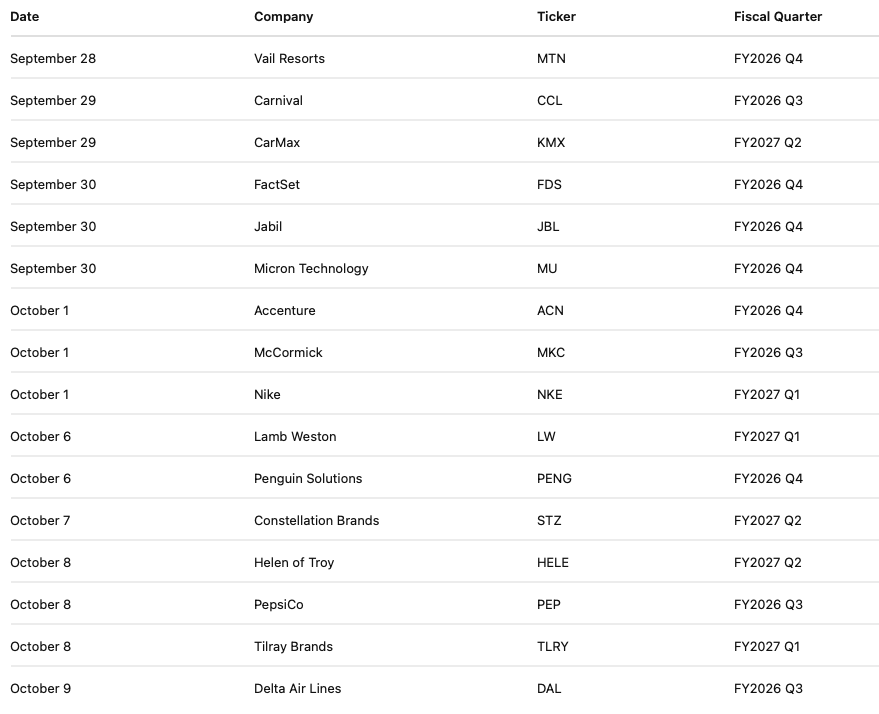
Reporting period: September 28–October 12, 2026
Portfolio Lens reviewed 16 earnings calls during this period.
Portfolio Lens analyzes corporate earnings, financial reports, and management commentary to identify changes in business performance, competitive strategy, and market conditions.
Visit Portfolio Lens to explore company analysis and earnings transcripts.