

Prefer to watch? Here’s the 2-minute summary:
Friday, November 13, 2026
Wall Street has always admired a good story. It admires a good earnings report even more, particularly when the numbers cooperate with the story. This week provided an unusually instructive collection of both. Cisco demonstrated that artificial intelligence can produce something more valuable than excitement: operating leverage. Applied Materials delivered record results without quite reaching any of our seven strong thresholds. CoreWeave grew rapidly enough to improve its operating economics, although its creditors still have plenty to celebrate. Nebius reported extraordinary growth while pushing part of its expected revenue into next year. And Take-Two Interactive discovered that anticipation for Grand Theft Auto VI does not automatically translate into spending on games already available.
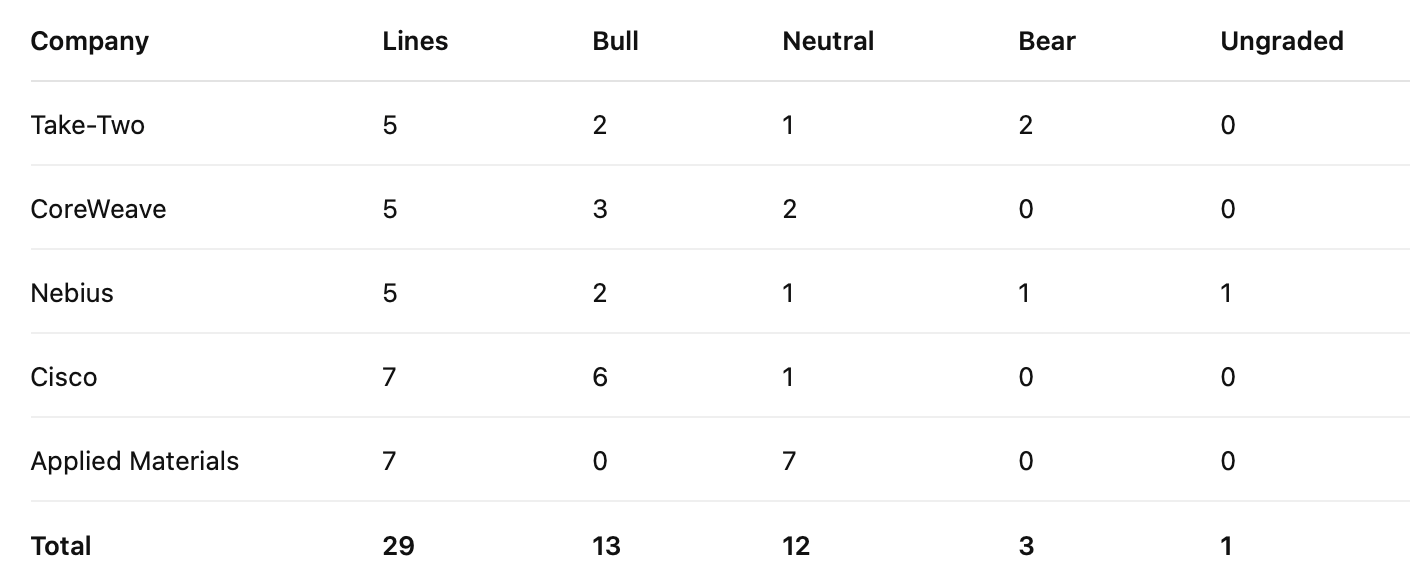
The five companies have little in common beyond their dependence on customers willing to spend money. Yet their earnings illustrate a useful distinction between growth and progress. Revenue can rise while margins fall. A record quarter can disappoint. A company can beat expectations for the present while quietly revising its promises for the future. That is why Portfolio Lens publishes its thresholds before earnings. This week we established 29 tests. Thirteen earned Bull grades, twelve earned Neutral and three earned Bear. One remains ungraded. The companies have supplied their explanations. The arithmetic has supplied its verdict.
How We Keep Score
Before each company reported, we published the results that would constitute a strong quarter and those that would constitute a weak one. Results at or beyond our strong thresholds earn Bull. Results at or beyond our weak thresholds earn Bear. Everything between earns Neutral. For costs, lower is better.
We grade against company earnings releases and SEC filings rather than analyst estimates. We do not change thresholds afterward. Undisclosed measures remain ungraded.
The purpose of scorecards is not to prove that we can see the future. It is to prevent ourselves from rewriting the past.
Take-Two Interactive: The Sequel Must Deliver
Fiscal Q2 2027 | Reported November 9
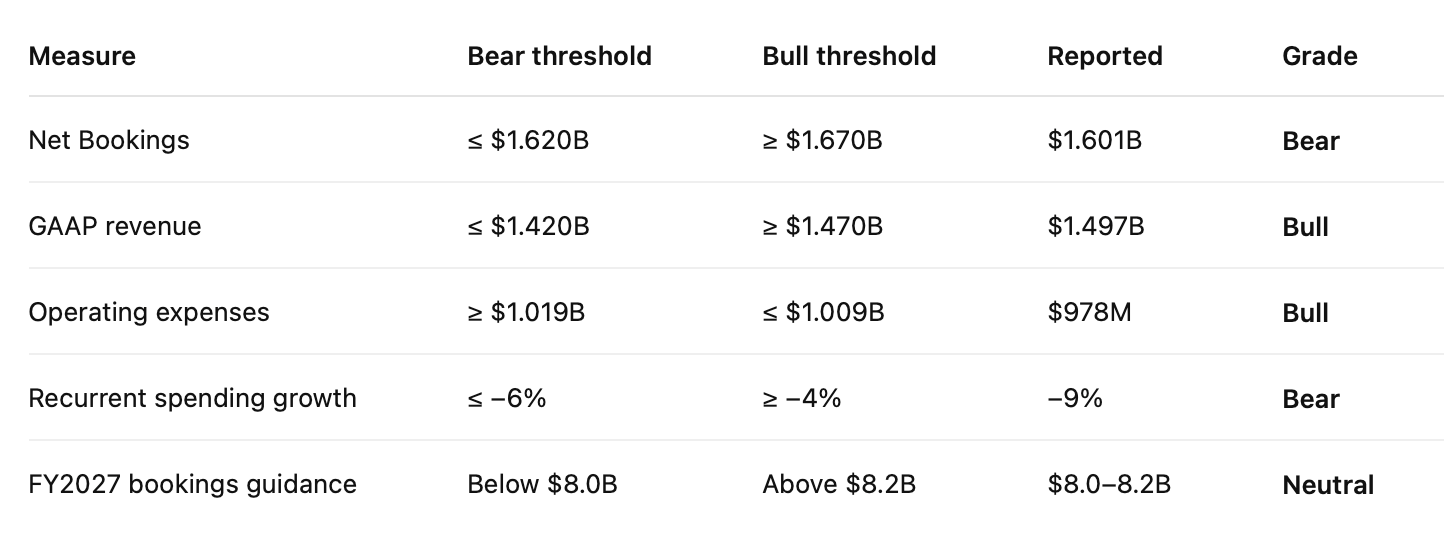
Two Bull. One Neutral. Two Bear.Hollywood has long understood that a successful sequel can redeem an indifferent predecessor. Video games operate under similar commercial principles, although shareholders must survive the intervening quarters.
Take-Two reported Net Bookings of $1.60 billion, below its own guidance. Recurrent consumer spending declined 9%, considerably worse than management’s expected 5% decline. Mobile bookings fell from $818 million to $708 million.
The company did better on GAAP revenue and expenses. Both cleared our strong thresholds.
Management maintained its $8.0–8.2 billion full-year bookings outlook. That leaves considerable responsibility resting on Grand Theft Auto VI, scheduled for November 19. Take-Two expects third-quarter bookings of $3.35–3.50 billion, roughly twice the comparable quarter last year. Management describes preorders as unprecedented but supplies no figures.
Enthusiasm is encouraging. Revenue is preferable.
CoreWeave: Growth Meets Its Creditors
Q3 2026 | Reported November 10
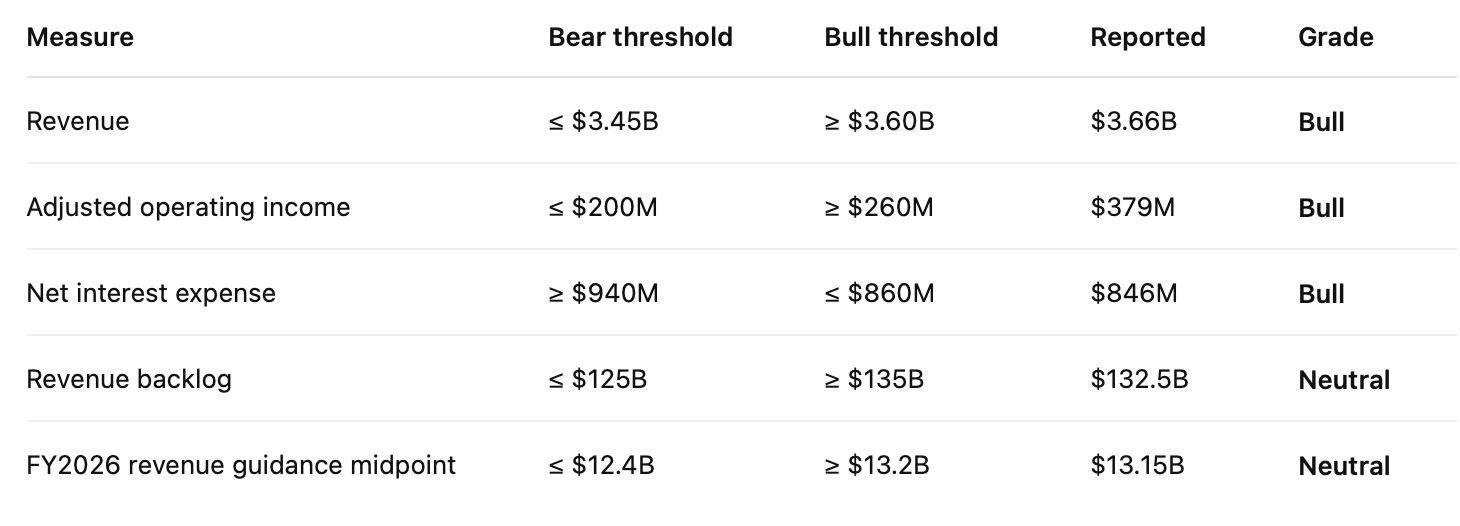
Three Bull. Two Neutral.
Artificial intelligence promises to eliminate tedious work. It has not eliminated interest payments. CoreWeave increased revenue 168% to $3.66 billion. Adjusted operating income reached $379 million, nearly three times the preceding quarter. Net interest expense, $846 million, came in under our strong line of $860 million. These are meaningful improvements.
Unfortunately, interest expense still exceeded adjusted operating income by more than two to one. The company reported a $709 million GAAP net loss and total indebtedness of $47.5 billion. While its backlog reached approximately $132.5 billion, full-year revenue guidance increased to $13.0–13.3 billion, although the midpoint remained just below our Bull threshold.
CoreWeave’s progress is genuine. So are its financial obligations. The question is no longer whether customers want AI computing power. It is whether enough of the revenue will remain after the lenders have collected their share.
Nebius: Tomorrow Arrives Two Months Late
Q3 2026 | Reported November 12
Two Bull. One Neutral. One Bear. One Ungraded.
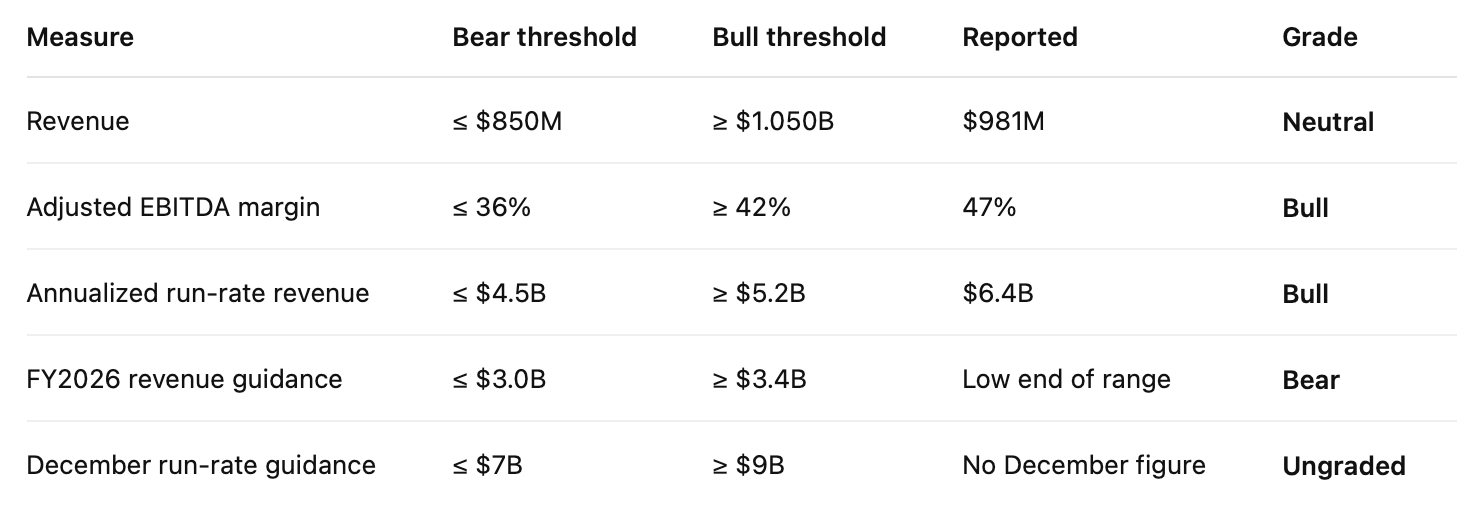
Nebius increased revenue 571% to $981 million. Its adjusted EBITDA margin reached 47% and annualized run-rate revenue climbed to $6.4 billion. Both measures cleared our strong thresholds. However, there is a complication. Approximately $325 million of revenue came from nonrecurring arrangements involving partner capacity. Management acknowledges that these transactions make run-rate comparisons less reliable.
The more consequential development concerns timing. Nebius now expects full-year revenue at the bottom of its previous $3.0–3.4 billion range. Its December run-rate objective has effectively moved to February. Management attributes the delay partly to third parties. Capital spending, meanwhile, has increased to approximately $27 billion for 2026. The company projects $40–45 billion for 2027.
Nebius is growing rapidly. Its customers are helping finance the expansion through substantial prepayments. But construction schedules have a stubborn habit of ignoring financial projections. The company has moved its calendar. Our thresholds remain where we published them.
Cisco: The Network Collects Its Reward
Fiscal Q1 2027 | Reported November 12
Six Bull. One Neutral.
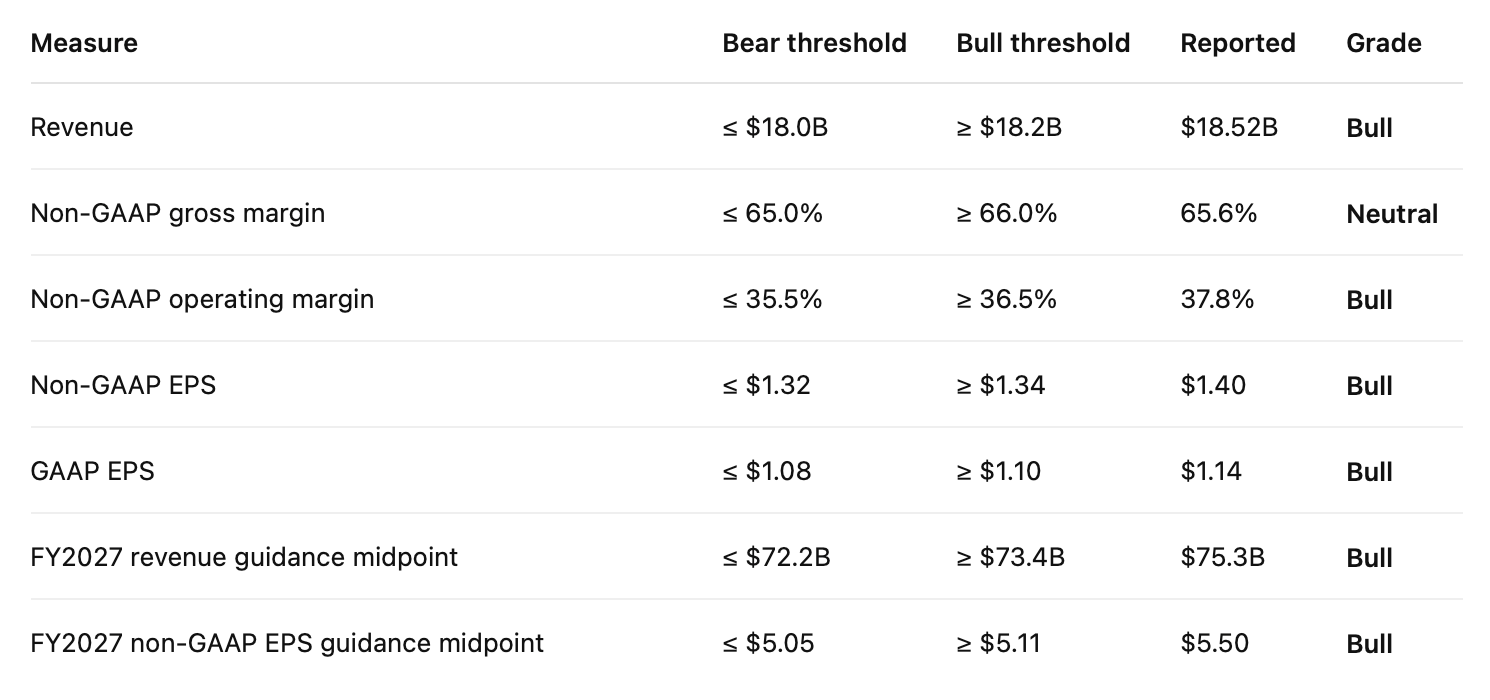
There is a difference between selling more equipment and building a more profitable business. Cisco managed both, although not quite everywhere. Revenue increased 24% to $18.5 billion. Networking revenue rose 43%. Non-GAAP operating margin reached 37.8% and earnings per share increased 40%. Gross margin slipped to 65.6%, down from 68.1% a year earlier. Hardware and memory costs continue to extract their price. Yet operating efficiency more than compensated.
Cisco raised its full-year revenue outlook to $74.8–75.8 billion and its non-GAAP earnings outlook to $5.47–5.53 per share. It now expects $9 billion in AI infrastructure revenue from hyperscalers this fiscal year. Chief Executive Chuck Robbins calls this the early stages of a networking supercycle.
Perhaps. What matters today is that Cisco has demonstrated operating leverage. Earnings are growing faster than revenue. That is a particularly agreeable arrangement for shareholders.
Applied Materials: Seven Respectable Answers
Fiscal Q4 2026 | Reported November 12
Seven Neutral. No Bull. No Bear.
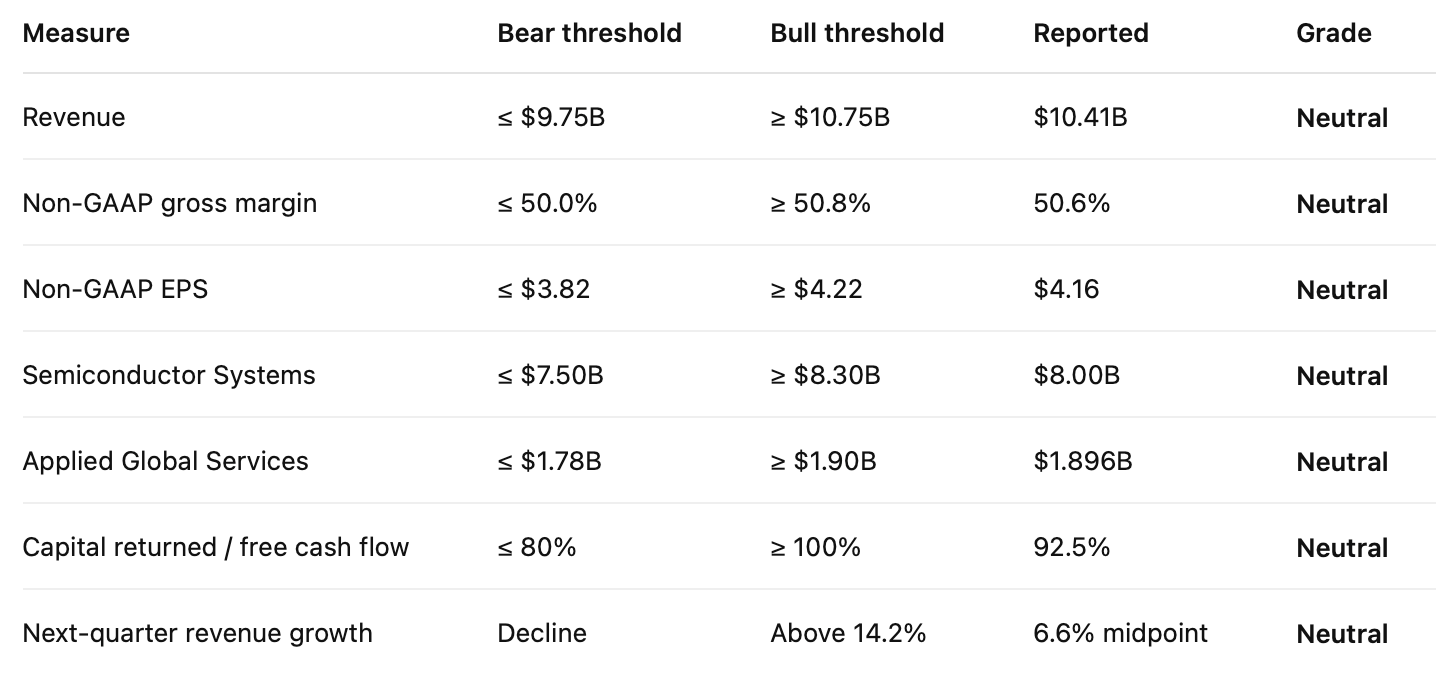
Applied Materials produced record revenue of $10.41 billion, an increase of 53%. Non-GAAP earnings rose 92% to $4.16 per share. Free cash flow reached $2.62 billion. And not one result earned a Bull grade.
This is not an indictment of the business. It is the consequence of publishing thresholds before knowing the results. Earnings missed our strong line by six cents. Applied Global Services missed by $4 million. Gross margin finished two-tenths of a percentage point short. Applied returned $2.42 billion to shareholders through dividends and repurchases, equivalent to 92.5% of free cash flow.
Its next-quarter revenue guidance implies approximately 6.6% sequential growth at the midpoint. That is respectable, although slower than the preceding quarter’s 14.2% increase. The quarter also contains an extra week. Applied is performing well. Our seven Neutral grades simply mean it did not reach the stronger results we established beforehand.
There is no disgrace in a good quarter. There is also no reason to award it a better grade than it earned.
The Scorecard
What Comes Next
Take-Two faces its November 19 Grand Theft Auto VI launch. Its full-year outlook increasingly depends on a successful second half.
CoreWeave expects fourth-quarter interest expense of $1.05–1.15 billion. Operating income must continue improving to keep pace.
Nebius must demonstrate that its delayed revenue arrives in February and that its ambitious expansion can be financed without sacrificing too much of the economics.
Cisco must defend its gross margin while delivering the operating leverage that made this quarter so successful.
Applied Materials must demonstrate that its extraordinary sales growth can continue without requiring ever-greater investment.
And Nvidia reports Tuesday, November 17. Our eight thresholds are already published.
The Difference Between a Story and a Scorecard
Five companies supplied five different versions of corporate progress. Cisco delivered the strongest scorecard. CoreWeave improved its economics but remains heavily indebted. Nebius demonstrated growth while postponing part of its timetable. Applied Materials delivered records without reaching our strongest thresholds. Take-Two enters its most important product launch with two fresh misses.
None of these outcomes requires us to rewrite the original tests.
Wall Street will always have explanations. Some will be persuasive. Others will be imaginative. The advantage of writing down the numbers first is that imagination cannot change them afterward.
Thresholds first. Grades later. Misses included.
Subscribe to Portfolio Lens Research to receive each scorecard when it lands.
Sources
Take-Two Q2 fiscal 2027 earnings release, Form 10-Q and prepared remarks, November 9, 2026.
CoreWeave Q3 2026 earnings release, Form 10-Q and earnings call, November 10–12, 2026.
Nebius Q3 2026 results and shareholder letter, November 12, 2026.
Cisco Q1 fiscal 2027 earnings release and prepared remarks, November 12, 2026.
Applied Materials Q4 fiscal 2026 earnings release, November 12, 2026.
Not investment advice. Research for informational purposes only. Investing involves risk, including loss of principal. Past performance does not indicate future results.