


October 30, 2026
There is a comforting assumption in business that demand is the hard part. Find enough customers, and prosperity will follow. Intel has discovered this theory can be inconvenient. Customers want more chips than the company can deliver. Its factories, not its salespeople, are the constraint. Demand may be a promise, but production is proof.
On October 29, before Intel reported, we published four thresholds in Intel’s Supply Test: How Much Could It Ship?. Readers can compare those numbers with Intel’s October 29 earnings release. Three results cleared our Bull thresholds: gross margin, earnings per share, and Data Center and AI revenue. Total revenue finished between our strong and weak lines. Intel had a good quarter. More importantly, the evidence is public. The standards were published before the results, and the scorecard followed afterward.
The Scorecard
Third quarter 2026. Financial results from Intel’s October 29 earnings release.
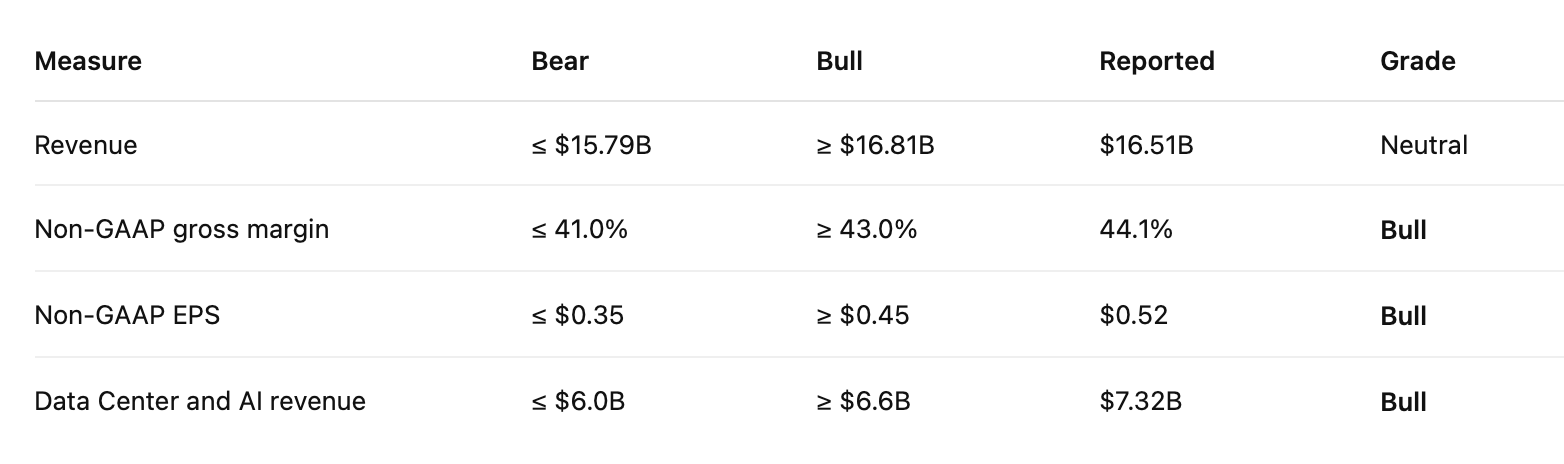
Final grade: Three Bull. One Neutral. No Bear.
Our rules are simple. We publish thresholds before earnings and grade against company disclosures, not analyst estimates. Results between Bull and Bear are Neutral. We never move the lines after the report.
What the Numbers Tell Us
Revenue: Strong demand, limited supply.
Intel reported $16.51 billion in revenue, up 21%, within management’s $15.8–16.8 billion guidance. Demand remained healthy, but production capacity continued to limit shipments.
Margins: The factories performed better.
Non-GAAP gross margin reached 44.1%, exceeding Intel’s 42% guidance. Better manufacturing performance matters because producing more chips is valuable only if Intel can do so profitably.
Earnings: Another beat.
Non-GAAP earnings reached $0.52 per share, above our $0.45 Bull threshold and more than double the previous year’s $0.23.
Data centers: The quarter’s strongest evidence.
Data Center and AI revenue jumped 78% to $7.32 billion. Intel’s CFO called it the company’s strongest data center revenue growth in 15 years.
But the enthusiasm was not universal. Client computing revenue fell 5% to $8.10 billion. Intel’s two principal businesses are moving in opposite directions.
Source: Intel Q3 2026 earnings release, Form 8-K, Exhibit 99.1, October 29.
The Running Record
With Intel included, our published scorecards now contain:
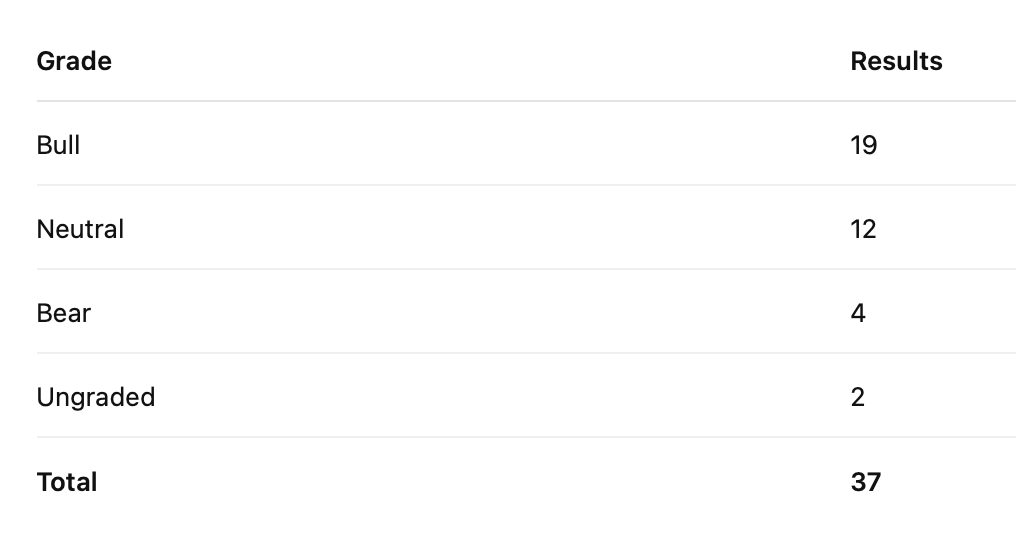
Thirty-five of 37 thresholds have been graded. The other two remain on the record because the companies did not disclose the required figures.
What Comes Next
Intel’s fourth-quarter guidance is less encouraging: revenue of $15–16 billion, non-GAAP gross margin of 38%, and earnings of $0.25 per share.
Three questions now matter.
Can Intel increase server production?
Will PC demand continue weakening?
Will its new 14A manufacturing process attract outside customers?
Intel says it released the 14A design kit in October, as promised. The next test is whether customers commit.
Demand Is a Promise. Production Is Proof.
Intel cleared three of our four thresholds. That is a strong result, but it is not a guarantee of future performance. The semiconductor industry has no shortage of ambitious forecasts. What it needs is production that fulfills them, margins that justify them, and earnings that survive them.
At Portfolio Lens, we apply the same discipline to our own work.
Thresholds first. Grades later. Misses included.
Subscribe free to Portfolio Lens Research for the next earnings previews and scorecards.
Sources: Intel Q3 2026 earnings release (October 29, 2026); Portfolio Lens Research preview (October 29, 2026).
For information only. Not investment advice. Nothing here is a recommendation to buy, sell, or hold any security.