


Thursday October 29, 2026
Capitalism usually presents manufacturers with a familiar problem: finding customers willing to buy what they produce. Intel has encountered the less comfortable alternative. Customers want more chips than the company can deliver. Second-quarter revenue climbed from $12.9 billion a year earlier to $16.1 billion, yet management insists the result could have been better. Demand, according to Intel’s finance chief, continues to exceed supply. Wafers, memory and substrates remain scarce. There is a certain irony in a semiconductor industry spending hundreds of billions of dollars to build the future while struggling to manufacture enough of the present.
Intel reports Thursday afternoon, and the question is no longer whether customers want its products. It is whether Intel can manufacture and deliver them profitably. The company exceeded its own financial expectations for seven consecutive quarters, according to CEO Lip-Bu Tan. In the second quarter, revenue exceeded the midpoint of guidance by $1.8 billion, Data Center and AI revenue rose 59%, and adjusted earnings more than doubled management’s forecast. Such results create an agreeable problem for executives: expectations rise faster than production capacity. At Portfolio Lens, we wrote down our Bull and Bear lines before the report. We will not revise them after the numbers arrive. Management may explain the past. Our scorecard will preserve what we expected of the future.
The Numbers Intel Must Deliver
Intel reports October 29, after the market closes. Its earnings call begins at 2:00 p.m. Pacific. What to watch for:
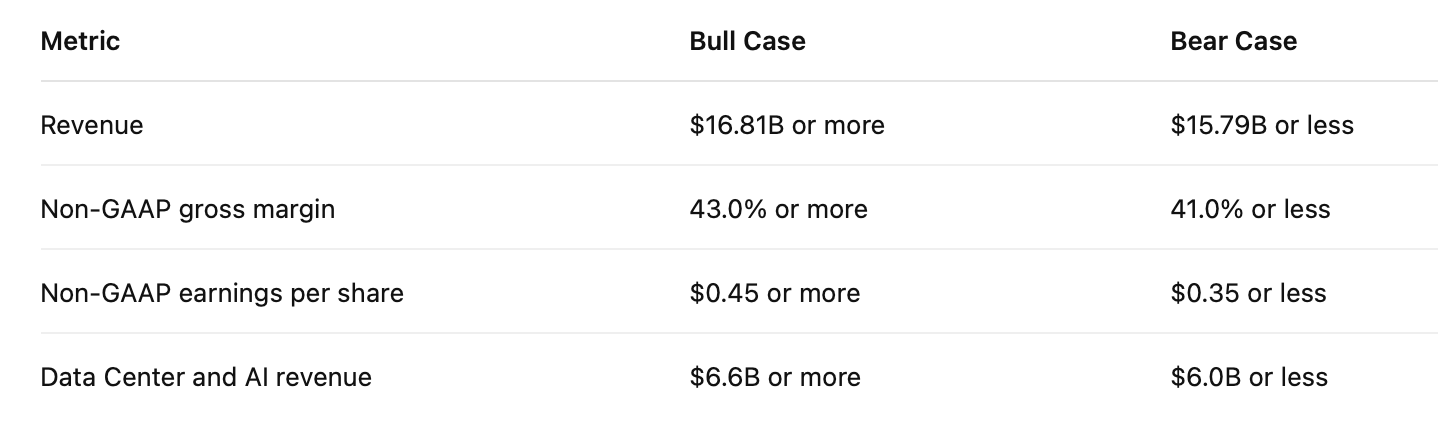
Results between these thresholds earn a Neutral grade.
Intel’s guidance calls for revenue of $15.8 billion to $16.8 billion, adjusted gross margin of 42%, and adjusted earnings of $0.38 per share.
Our Bull thresholds exceed management’s guidance. After seven consecutive quarters of exceeding expectations, merely meeting the forecast is not particularly revealing.
Capital spending, which Intel raised to more than $20 billion for 2026, will be tracked but not graded.
Three Questions Worth Asking
First, can Intel deliver the chips?
Management expects additional manufacturing capacity to become available late in the quarter, particularly for servers. Data Center and AI revenue reached $6.3 billion last quarter, up 59%. Our $6.6 billion Bull threshold tests whether greater production capacity translates into additional sales.
Second, can Intel protect its margins?
Last quarter’s adjusted gross margin reached 41.8%, nearly three percentage points above guidance. Better manufacturing yields and pricing helped. Another improvement would suggest that Intel is becoming more efficient, not merely selling more products.
Third, can Intel attract customers to its factories?
In July, CEO Lip-Bu Tan said the design kit for Intel’s next-generation 14A manufacturing process was on track for October. That kit gives outside chip designers the technical information needed to develop products for Intel’s factories. A working design kit is not a customer contract. But without it, those contracts become considerably harder to secure.
What Intel Tells Us About the AI Economy
Microsoft, Alphabet and Amazon are committing enormous sums to AI infrastructure. Intel’s results offer a different perspective on that spending. When demand is greater than supply, revenue measures manufacturing capacity as much as customer appetite. That distinction matters. A company can have willing customers, attractive prices and an expanding market, yet still disappoint investors because its factories cannot deliver.
Intel’s next quarter will test whether supply constraints are easing, margins are improving and its foundry ambitions are progressing. Demand is a promise. Production is proof. We will grade Intel against these published thresholds in our next scorecard.
Thresholds first. Grades later. Misses included.
Subscribe to Portfolio Lens Research to receive the results.
Sources: Intel Q2 2026 earnings release (8-K, Exhibit 99.1, July 23, 2026); Intel Q2 2026 earnings call (July 23, 2026); Intel Q3 earnings announcement (October 6, 2026).
For information only. Not investment advice. Nothing in this article is a recommendation to buy, sell or hold any security.