

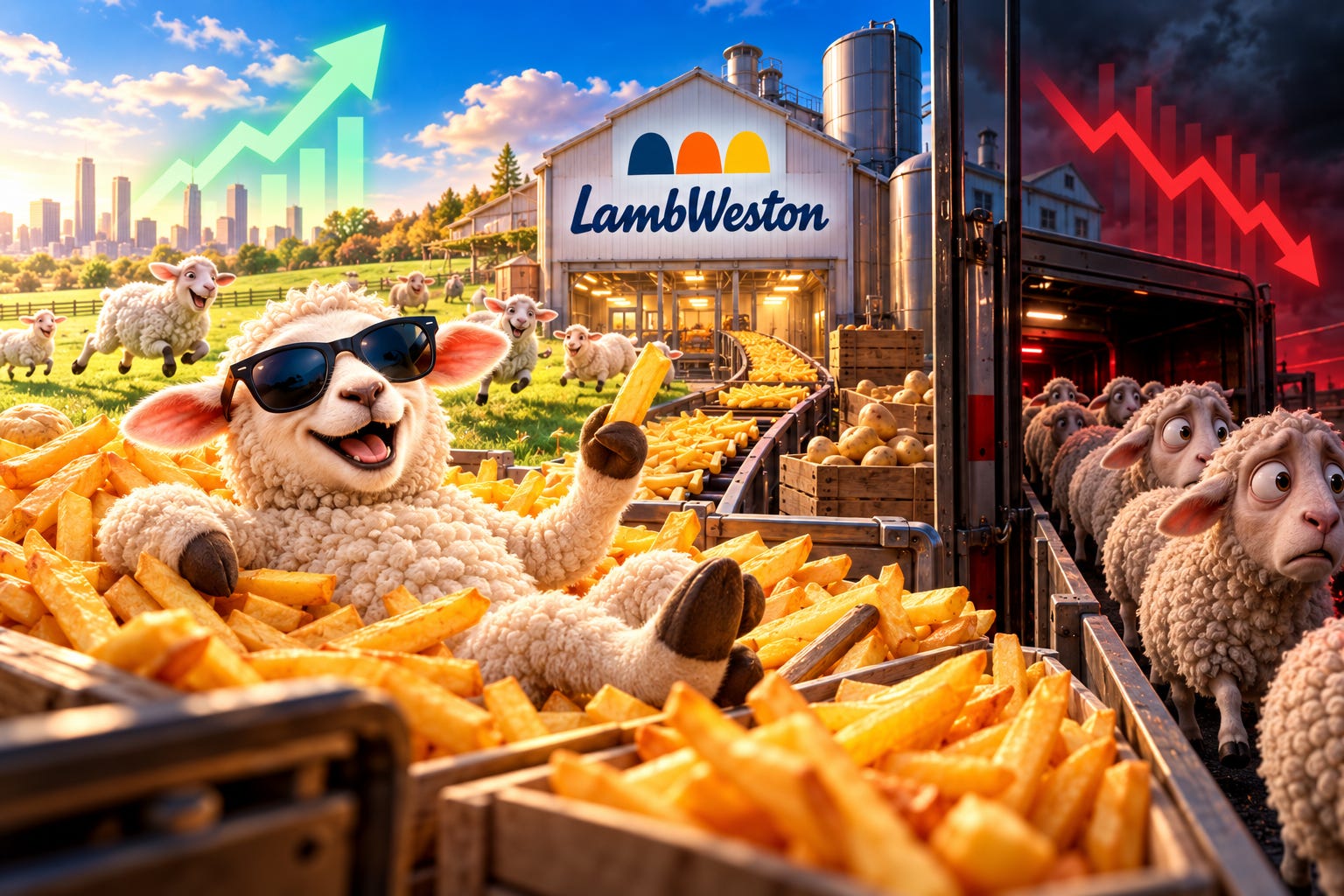
One of the real questions in this economy, is how is the average American doing? GDP growth is ripping, but is that only AI or is that being extended to the rest of the economy? We will get a good reading on that from Lamb Weston’s release on October 6th.
Bull Case
The bull case is good for Lamb and an indicator for the rest of use. It needs to accelerate North American volume growth to at least 3% or more and see realization of their Focus to Win cost efficiencies. Gross margins need to be 21% or more and deliver an adjusted EBITDA of $305M or more.
Consolidated net sales: at or above $1,675.0 million for Q1 FY2027 [0001679273-25-000070, transcript:FY2026-Q4].
North America segment sales volume growth: at or above 3.0% year-over-year for Q1 FY2027 [transcript:FY2026-Q4].
Consolidated gross profit margin: at or above 21.0% for Q1 FY2027 [0001679273-25-000070, transcript:FY2026-Q4].
Consolidated adjusted EBITDA: at or above $305.0 million for Q1 FY2027 [transcript:FY2026-Q1, transcript:FY2026-Q4].
Diluted earnings per share: at or above $0.50 per share for Q1 FY2027 [0001679273-25-000070, transcript:FY2026-Q4].
Full-year FY2027 adjusted diluted EPS guidance: raised above the initial midpoint of $3.10 per share or the upper band raised above $3.25 per share [transcript:FY2026-Q4].
Bear Case
If the bears go on a rampage, it’ll be because they’re hurt by many of the same issues effecting the economy. Middle East shipping disruptions and spot edible oil inflation may depress gross margins to 19.5% or less and EBITDA to $270 M or less.
Consolidated net sales: at or below $1,630.0 million for Q1 FY2027 [0001679273-25-000070, transcript:FY2026-Q4].
North America segment sales volume growth: at or below 0.0% year-over-year for Q1 FY2027 [transcript:FY2026-Q4].
Consolidated gross profit margin: at or below 19.5% for Q1 FY2027 [0001679273-25-000070, transcript:FY2026-Q4].
Consolidated adjusted EBITDA: at or below $270.0 million for Q1 FY2027 [transcript:FY2026-Q1, transcript:FY2026-Q4].
Diluted earnings per share: at or below $0.40 per share for Q1 FY2027 [0001679273-25-000070, transcript:FY2026-Q4].
Full-year FY2027 adjusted diluted EPS guidance: lowered below the initial range of $2.95 to $3.25 per share [transcript:FY2026-Q4].
Why this Filing Matters
The Q1 FY2027 earnings release on October 6, 2026, matters because it provides the immediate empirical test of management’s FY2027 margin bridge, specifically testing whether carryover finished-goods cost pressures can be managed without derailing the company’s full-year earnings targets. On the FY2026 Q4 earnings call, incoming Chief Financial Officer James Derek Gray explicitly committed to an FY2027 outlook where earnings outpace sales—projecting net sales flat to up 1% against a 52-week adjusted base of $6.5 billion, adjusted operating income of $720 million to $800 million, adjusted EBITDA of $1.1 billion to $1.2 billion, and adjusted diluted earnings per share (EPS) of $2.95 to $3.25 (compared to $2.90 on a 52-week adjusted basis in FY2026) [transcript:FY2026-Q4].
What this release specifically settles is the magnitude of the margin trough created by elevated input costs entering the fiscal year. Management disclosed on the Q4 call that volatile inflation in edible oils—driven by biodiesel demand and spot market exposures—along with elevated transportation and shipping costs from Middle East disruptions, were capitalized into finished goods inventory at the close of FY2026 and must be flushed through the income statement during Q1 FY2027 [transcript:FY2026-Q4]. The Q1 print will establish whether gross margin absorbs this inventory flush within the anticipated cadence or whether non-potato cost inflation will dilute the benefits expected from the 2026 raw potato crop deflation, where North American contract prices were negotiated down low- to mid-single digits and European contracts pointed to a mid-teens percentage decline [transcript:FY2026-Q4, transcript:FY2026-Q3].
Investors should watch two specific operational metrics at this event:
North America Volume Growth and Price/Mix Trajectory: Lamb Weston closed FY2026 with six consecutive quarters of volume expansion, including 11% volume growth in North America in Q4 FY2026 alongside a 2% decline in price/mix [transcript:FY2026-Q4]. For FY2027, management guided North America to low-single-digit volume growth and low-single-digit price/mix decline [transcript:FY2026-Q4]. Q1 will reveal whether customer contract retention, share gains, and previously curtailed production lines brought back online continue to deliver positive volume leverage, or whether the ongoing channel mix shift toward chain restaurants and private label retail further erodes net realized pricing [transcript:FY2026-Q4].
International Footprint Rationalization and Cost Savings Milestones: Following the permanent closure of the older facility in Monroe, Argentina, and the announced plan to close the Broekhuizenvorst plant in the Netherlands (representing approximately 10% of EMEA production capacity) [transcript:FY2026-Q4], Q1 results will show whether international fixed cost absorption is stabilizing. Furthermore, the report will provide progress against the company’s multi-year “Focus to Win” cost savings initiative, which exceeded its initial $100 million first-year run-rate target in FY2026 toward an ultimate target of at least $250 million in annual run-rate savings by FY2028 [transcript:FY2026-Q4].