

Prefer to watch? Here’s the 2-minute summary:
November 12, 2026
Investors have developed an understandable affection for Nvidia. Few companies have made so much money supplying the machinery of other people’s ambitions. The artificial intelligence revolution requires enormous quantities of computing power, and Nvidia has become its indispensable merchant. Revenue doubled in its latest quarter. Customers continue ordering systems that cost fortunes. We have learned to expect extraordinary results, which creates a peculiar difficulty: Extraordinary is no longer necessarily good enough. Nvidia reports Tuesday, November 17. Eight financial tests will help distinguish another remarkable quarter from one that merely meets expectations.
Yet financial statements cannot measure everything that matters. CEO Jensen Huang has reported resigned. Nvidia’s board now needs to find a replacement CEO, CFO Colette Kress is the interim CEO. This does not change the company’s technological achievements. Business history offers an enduring lesson: Great companies require more than great products and personal judgment can become a corporate concern. For our purposes, the earnings examination remains where it belongs: on the numbers management has promised to deliver.
Where Nvidia Stands
Nvidia’s fiscal third quarter ended October 25, 2026. In the preceding quarter, revenue reached $96.2 billion, up 106% from a year earlier. Data Center contributed $89.0 billion. Gross margin was 75.0% and non-GAAP earnings reached $2.22 per share.
GAAP earnings were higher at $2.46 because they included $7.8 billion in investment gains. Our earnings threshold uses non-GAAP results to avoid confusing investment appreciation with operating performance. For the third quarter, management guided revenue to $108 billion, plus or minus 2%, and gross margin to 74%, plus or minus half a percentage point. The forecast assumes no Data Center computing revenue from China.
Eight Tests Before the Results
We established these thresholds November 12, before Nvidia reports. Results reaching the strong line earn Bull. Results reaching the weak line earn Bear. Everything between earns Neutral.
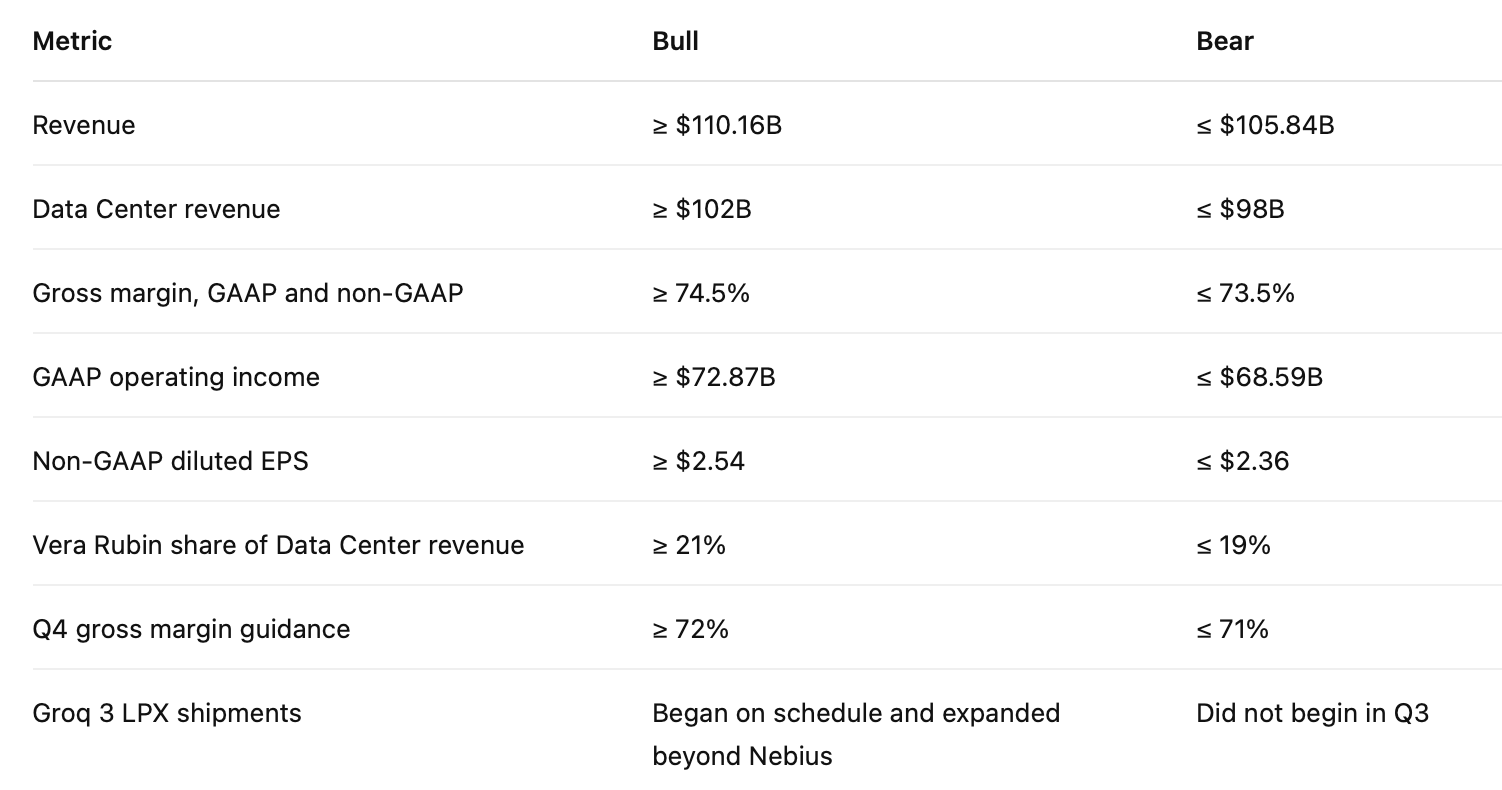
For Groq 3 LPX, shipments beginning on schedule with initial adopters earn Neutral. If Nvidia does not disclose Rubin’s revenue share or LPX shipment status, the corresponding line remains ungraded. Our revenue, gross margin and operating income thresholds reflect management’s guidance. The remaining thresholds test the execution behind those forecasts.
Vera Rubin: The Next Expensive Necessity
Nvidia’s next AI platform, Vera Rubin, is entering volume production. In August, Huang described it as being in full production. Finance chief Colette Kress estimated that Rubin would account for approximately 20% of third-quarter Data Center revenue.
That percentage matters because Nvidia expects to extract considerably more revenue from each unit of computing infrastructure. Kress estimated revenue opportunities of $25 billion per gigawatt with Blackwell and $40 billion with Rubin. The opportunity is substantial. So is the obligation to deliver.
Memory: The Revolution Has a Supply Bill
Nvidia’s gross margin reached 75% last quarter, but rising memory prices are changing the economics. Management expects approximately 74% this quarter, followed by a fourth-quarter bottom of 71–72%. It anticipates recovery toward 72–73% in fiscal 2028 as price increases take effect.
Supply commitments climbed from $119 billion to $279 billion, primarily because of memory procurement. Nvidia is committing enormous sums today to satisfy demand tomorrow. Our fourth-quarter margin threshold tests whether the expected deterioration remains contained. Revenue growth is impressive. Revenue growth accompanied by declining profitability deserves closer inspection.
Groq: Speed Becomes the Product
Groq 3 LPX introduces another dimension to Nvidia’s strategy. Built using technology licensed from Groq, the inference accelerator is designed to generate AI responses rapidly. Nebius is the first announced adopter. Nvidia expected volume shipments during the third quarter, initially to early customers.
The distinction between production announcements and revenue shipments matters. Manufacturing a product is an achievement. Delivering it to paying customers is a business.
What the Numbers Will Tell Us
Nvidia’s largest cloud customers generated $48.7 billion in Data Center revenue last quarter. AI clouds, industrial customers and enterprises contributed another $40.3 billion. Management expects the latter group to drive third-quarter growth before hyperscale demand accelerates again.
The central question is whether Nvidia can maintain extraordinary growth while absorbing higher component costs and introducing increasingly complex systems. We will grade all eight thresholds after Tuesday’s report. We do not move the lines after seeing the results. The purpose is not to predict the future perfectly. It is to prevent ourselves from rewriting the past.
Eight numbers can measure a quarter. They cannot measure the risk facing a company.
Thresholds first. Grades later. Misses included.
Subscribe to Portfolio Lens Research to receive the scorecard when it lands.
Sources: Nvidia fiscal Q2 2027 earnings release, CFO commentary, Form 10-Q and earnings call (August 26, 2026); Nvidia Groq 3 LPX announcement (August 24, 2026); Nvidia earnings announcement (October 28, 2026). Governance background: Reuters and Associated Press reporting, November 9–11, 2026.
Not investment advice. Research for informational purposes only. Investing involves risk, including loss of principal. Past performance does not indicate future results.