

Saturday October 24th, 2026
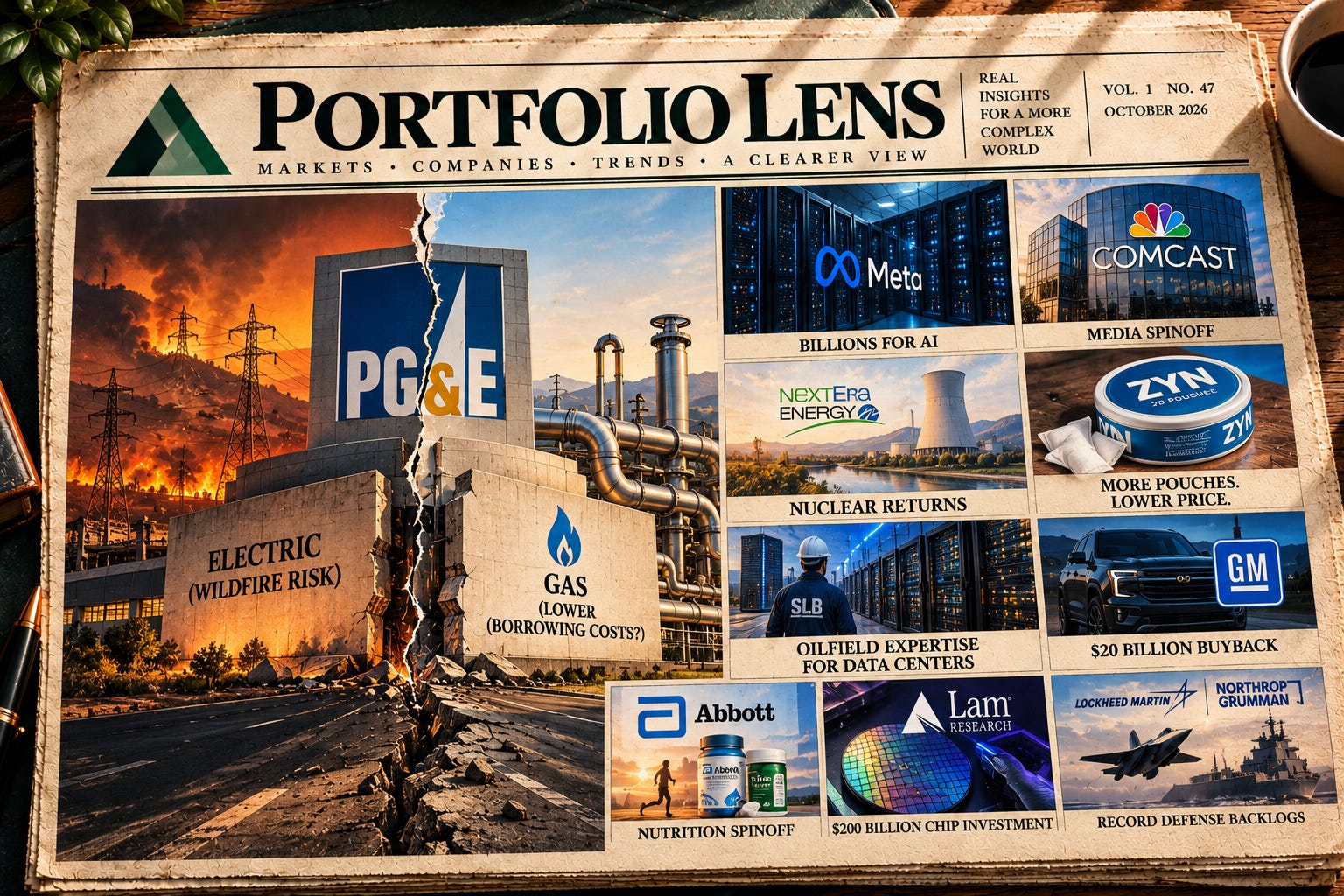
Capitalism has a curious habit of building great enterprises through consolidation, then discovering that their parts might be worth more apart. The conglomerate was once celebrated as an instrument of efficiency, spreading risk across businesses and placing diverse operations under one management. Today, PG&E is considering whether its gas customers might be better served without the financial burdens of its electric utility. Abbott wants to separate nutrition from medical technology. Comcast is preparing to divide its media operations from its communications business. The common problem is not that these businesses have suddenly become unprofitable. It is that the financial consequences of keeping them together may now exceed the advantages of doing so. Corporate structure, once treated as a matter of organization, has become a question of economic survival.
Elsewhere, companies are making equally consequential choices about where to spend their money. Meta is investing billions in artificial intelligence while legal liabilities consume cash. NextEra is bringing a retired nuclear reactor back to life, with federal financing helping to pay the bill. Schlumberger, a company built around extracting energy from the earth, sees a growing business in cooling and powering the machines that process artificial intelligence. Meanwhile, General Motors is preparing to return $20 billion to shareholders, and defense contractors are accumulating orders faster than they can deliver equipment. These developments suggest that the defining corporate question is no longer simply how much a company can grow, but where its capital can earn the best return. The answers are reshaping industries that once seemed settled.
What We Heard
Utilities | PG&E Considers Breaking Apart
PG&E (PCG) is evaluating whether to separate its natural gas operations from its electric utility.
CEO Patricia Poppe said approximately four million gas customers face higher borrowing costs because the combined company’s credit profile reflects wildfire risks associated with its electric operations.
Management is considering a sale, spinoff or other separation if policy reforms cannot address the problem.
The issue is straightforward: Gas customers are paying a financial penalty for risks associated with a different business.
Why it matters: A separation could reduce financing costs for the gas utility. It could also establish a precedent for other utilities facing large climate-related liabilities.
Source: Patricia Kessler Poppe, CEO, FY2026 Q3 earnings call.
Communication Services | Meta’s AI Bill Comes Due
Meta (META) reported negative free cash flow of $2.1 billion in the third quarter, despite revenue growth of 26%.
Capital expenditures, including finance-lease principal payments, reached $34.9 billion. A $9.9 billion legal settlement charge also weighed on reported earnings.
The results illustrate the financial demands of Meta’s AI infrastructure expansion.
Unlike cloud providers that sell computing capacity, Meta must recover much of its investment through advertising performance.
Why it matters: Strong advertising growth must eventually translate into sufficient cash generation to support Meta’s infrastructure spending.
Source: Susan Li, CFO, FY2026 Q3 earnings call.
Communication Services | Comcast Prepares to Separate Its Media Business
Comcast (CMCSA) expects to complete a planned media spinoff by the middle of next year.
Management said the company is building the systems and corporate infrastructure required for an independent public business.
The separation reflects the different economics of broadband connectivity and traditional entertainment.
Why it matters: Independent companies could allocate capital more effectively, although each would lose some benefits of operating within a larger organization.
Source: Mike Cavanagh, FY2026 Q3 earnings call.
Utilities | NextEra Brings Nuclear Power Back
NextEra Energy (NEE) secured a Department of Energy loan of up to $1.9 billion to support the restart of Iowa’s Duane Arnold nuclear plant.
Management expects the facility to return to service no later than the first quarter of 2029.
The project reflects renewed interest in reliable, carbon-free electricity as power demand increases.
Why it matters: A successful restart could provide a model for restoring other retired nuclear facilities, although regulatory approvals and engineering risks remain.
Source: John Ketchum, CEO, FY2026 Q3 earnings call.
Consumer Staples | Philip Morris Cuts ZYN’s Effective Price
Philip Morris (PM) is increasing its flagship ZYN cans from 15 to 20 nicotine pouches without raising the package price.
Customers receive 33% more product, reducing the effective price per pouch by 25%.
The company is accepting near-term revenue pressure to defend its market position.
Why it matters: Lower prices could support volume growth but place pressure on profitability if competitors respond.
Source: Massimo Andolina, CFO, FY2026 Q3 earnings call.
Energy | Schlumberger Finds a New Market in AI
Schlumberger (SLB) expects its data center solutions business to exceed a $1 billion annual revenue run rate by the end of 2026 and surpass $2 billion in 2027.
The company is applying its industrial cooling and power expertise to data center infrastructure.
This creates a potential growth business outside traditional oilfield services.
Why it matters: AI infrastructure spending is creating opportunities for established industrial companies, not just semiconductor manufacturers.
Source: Olivier Le Peuch, CEO, FY2026 Q3 earnings call.
Consumer Discretionary | GM Plans a $20 Billion Buyback
General Motors (GM) announced a new $20 billion multiyear share repurchase authorization.
CFO Paul Jacobson said the authorization represents more than 25% of the company’s market capitalization.
The announcement signals management’s willingness to return substantial capital to shareholders.
Why it matters: Repurchases could increase earnings per share by reducing shares outstanding. However, an authorization is not a commitment to purchase the full amount, and the benefit depends on the price paid.
Source: Paul Jacobson, CFO, FY2026 Q3 earnings call.
Health Care | Abbott Separates Nutrition
Abbott (ABT) announced plans to establish its nutrition business as an independent, publicly traded company.
The separation would allow Abbott to concentrate on medical devices, diagnostics and other remaining operations.
Management expects the change to improve the remaining company’s growth profile and operating margins.
Why it matters: The transaction could improve capital allocation, but the benefits will depend on execution costs and the financial performance of both companies.
Source: Robert Ford, CEO, FY2026 Q3 earnings call.
Information Technology | Lam Research Sees a $200 Billion Equipment Market
Lam Research (LRCX) expects global wafer fabrication equipment spending to exceed $200 billion in 2027.
Management expects DRAM equipment to lead percentage growth, followed by advanced foundry logic and NAND.
The forecast reflects continued investment in semiconductor capacity and advanced manufacturing.
Why it matters: AI demand could sustain a multiyear equipment expansion, although semiconductor spending remains cyclical.
Source: Tim Archer, CEO, FY2027 Q1 earnings call.
Industrials | Defense Orders Outpace Deliveries
Lockheed Martin (LMT) reported a record $292 billion backlog and a book-to-bill ratio of 4.0.
Northrop Grumman (NOC) reported a record $110 billion backlog and a book-to-bill ratio of 1.5.
Book-to-bill compares new orders with revenue recognized during the period. A ratio above 1.0 indicates that orders exceed current sales.
Both companies are accumulating substantial future work.
Why it matters: Large backlogs improve revenue visibility, but manufacturing capacity and supply chains will determine how quickly orders become sales.
Sources: Evan Scott, Lockheed Martin CFO, and Kathy Warden, Northrop Grumman CEO, FY2026 Q3 earnings calls.
The Portfolio Lens Perspective
Three developments connect this week’s corporate reports.
First, corporate structure is becoming a financial decision. PG&E, Comcast and Abbott are reconsidering whether businesses should remain together. Their decisions reflect differences in risk, capital requirements and growth opportunities.
Second, AI investment is reaching beyond technology companies. Meta is building computing infrastructure, Schlumberger is supplying data center solutions, and NextEra is restoring nuclear generating capacity. The AI economy increasingly depends on electricity, cooling systems and industrial equipment.
Third, capital allocation is becoming more consequential. GM is returning billions to shareholders, while defense contractors are managing record order books. Philip Morris is sacrificing near-term pricing to protect market share.
These companies face different challenges, but the underlying question is the same: Where should the next dollar go?
The answer will determine which businesses create lasting value and which discover that yesterday’s successful strategy has become tomorrow’s expensive obligation.
Growth attracts attention. Returns determine the outcome.
Source note: Findings are based on the earnings-call excerpts supplied for this article. Direct transcript links were not provided. The commentary distinguishes management statements from Portfolio Lens interpretations.
For information only. Not investment advice. Nothing in this article is a recommendation to buy, sell or hold any security.