

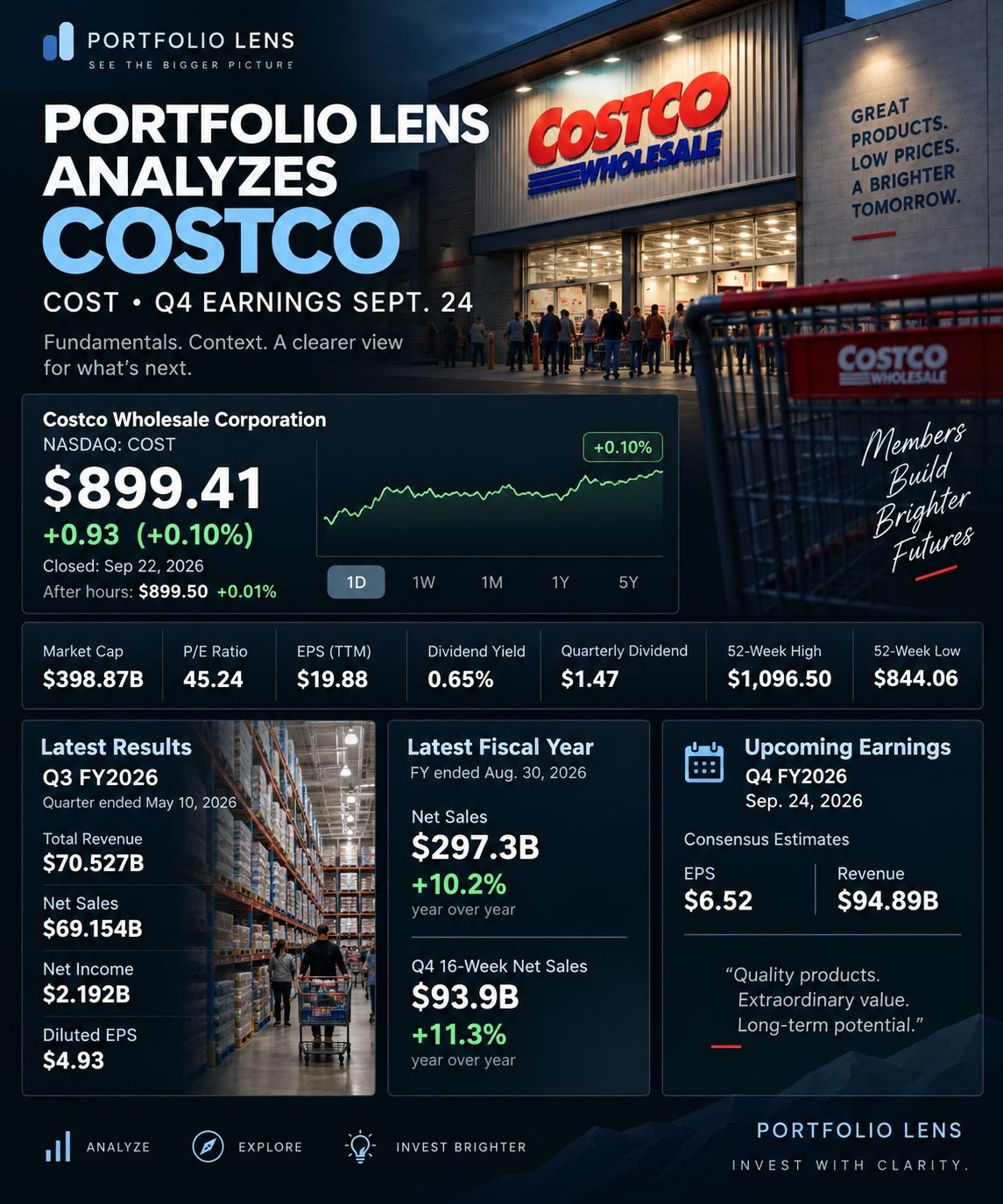
Costco is one of the most beloved and consistent performers. It is a company that people not only buy from, but they also buy their stocks. With that in mind, I’ll tenderly look at the bull case, the bear case, and why this event matters.
Bull Case
For Costco to hit its bull case, comparable sales need to reach 7% or higher, and diluted EPS needs to be at or above $6.65. Equally, it would help if digital growth exceeds 22% and management accelerates their FY 2027 expansion plans. For this to be true, we would expect to see the following:
Total revenue (Q4 FY2026, 16 weeks): At or above $93.00 billion (representing total revenue growth of 7.9% or higher versus $86.16 billion in Q4 FY2025 [financials:FY2025-Q4]).
Comparable sales growth (adjusted for gas price impacts and foreign exchange, Q4 FY2026): At or above 7.0% (accelerating from 6.6% in Q3 FY2026 [transcript:FY2026-Q3] through accelerated market share gains in core merchandise, pharmacy, and food).
Diluted earnings per share (Q4 FY2026, 16 weeks): At or above $6.65 per share (net income at or above $2.95 billion, representing year-over-year EPS growth of 13.3% or higher versus $5.87 in Q4 FY2025 [transcript:FY2025-Q4], supported by retail media monetization and labor productivity improvements).
Digitally-enabled comparable sales growth (adjusted for foreign exchange, Q4 FY2026): At or above 22.0% (improving from 20.8% in Q3 FY2026 [transcript:FY2026-Q3], driven by expanded third-party same-day delivery partnerships and AI personalization conversion gains).
Full-year net new warehouse openings (FY2026): At or above 27 net new openings (total worldwide warehouse count at or above 941, recovering delayed pipeline projects and beating the revised 26-unit full-year schedule [transcript:FY2026-Q3]).
Bear Case
It would almost be interesting if the bear case came to pass. I really wonder whether it would affect stock performance by more than 1% or 2%. For the bear case to come into play, fourth-quarter adjusted comparable sales need to drop to 5.5% or below. The full-year net new warehouse openings need to fall to 22 or fewer, and execution delays need to compound. For this to be true, we would expect to see the following:
Total revenue (Q4 FY2026, 16 weeks): At or below $90.50 billion (representing total revenue growth of 5.0% or less versus $86.16 billion in Q4 FY2025 [financials:FY2025-Q4]).
Comparable sales growth (adjusted for gas price impacts and foreign exchange, Q4 FY2026): At or below 5.5% (down from 6.6% in Q3 FY2026 [transcript:FY2026-Q3], driven by lapping the ~1% weekly U.S. sales lift from extended club hours [transcript:FY2025-Q4] and consumer discretionary spending pullbacks).
Diluted earnings per share (Q4 FY2026, 16 weeks): At or below $6.25 per share (net income at or below $2.78 billion, representing year-over-year EPS growth of 6.5% or less versus $5.87 in Q4 FY2025 [transcript:FY2025-Q4], as tariff-refund price reductions compress merchandise gross margins without driving offsetting volume).
Digitally-enabled comparable sales growth (adjusted for foreign exchange, Q4 FY2026): At or below 16.0% (decelerating from 20.8% in Q3 FY2026 [transcript:FY2026-Q3]).
Full-year net new warehouse openings (FY2026): At or below 22 net new openings (total worldwide warehouse count at or below 936, reflecting further construction or permitting delays beyond the two units already deferred to FY2027 [transcript:FY2026-Q3]).
Why this Event Matters
The fourth-quarter and full-year fiscal 2026 earnings release on September 24, 2026, settles two central operational trajectories that management adjusted across the fiscal year: the execution of its scaled-back warehouse expansion schedule and the receipt and treatment of International Emergency Economic Powers Act (IEEPA) tariff refunds.
First, this report provides the final accounting for fiscal 2026 unit expansion and capital deployment. Management initially guided to 35 warehouse openings (30 net new buildings and 5 relocations) with an accelerated capital expenditure budget [transcript:FY2025-Q4], but subsequent permitting and construction delays in Spain forced successive reductions to 28 net new openings in the first quarter [transcript:FY2026-Q1] and ultimately 26 net new openings in the third quarter, while maintaining a $6.5 billion annual capital expenditure target [transcript:FY2026-Q3]. Having closed the third quarter with 928 warehouses worldwide [transcript:FY2026-Q3], the fourth-quarter report tests whether Costco delivered its remaining project pipeline on schedule to achieve the revised 26 net new warehouse additions or deferred further projects into fiscal 2027.
Second, the event resolves the initial financial flow of IEEPA tariff refunds. In the third-quarter call, management disclosed that it began submitting claims through U.S. Customs and Border Protection and anticipated receiving approved refund distributions on a rolling basis over the subsequent two to three months—a window landing directly in the fourth quarter [transcript:FY2026-Q3]. Because management committed to returning the customer-funded portion of these duties via lower warehouse prices while navigating related litigation [transcript:FY2026-Q2, transcript:FY2026-Q3], this report is the first opportunity to observe the realized cash inflow, any margin impact from targeted price cuts, and the legal parameters governing member reimbursements.
Additionally, the fourth quarter marks the first period where Costco fully laps the June 30, 2025 implementation of extended operating hours (early morning entry for Executive members and extended Saturday evening hours), which management estimated provided an ongoing ~1% lift to weekly U.S. sales throughout fiscal 2025 and 2026 [transcript:FY2025-Q4]. With overall paid membership growth moderating to 4.1% year-over-year in the third quarter (82.9 million paid members) and the September 2024 fee increase now mostly cycled [transcript:FY2026-Q3], fourth-quarter results will establish whether core comparable sales momentum—which held between 6.4% and 6.7% excluding gas and foreign exchange over prior quarters [transcript:FY2025-Q4, transcript:FY2026-Q1, transcript:FY2026-Q2, transcript:FY2026-Q3]—can sustain mid-single-digit levels without the benefit of incremental operating hours.