

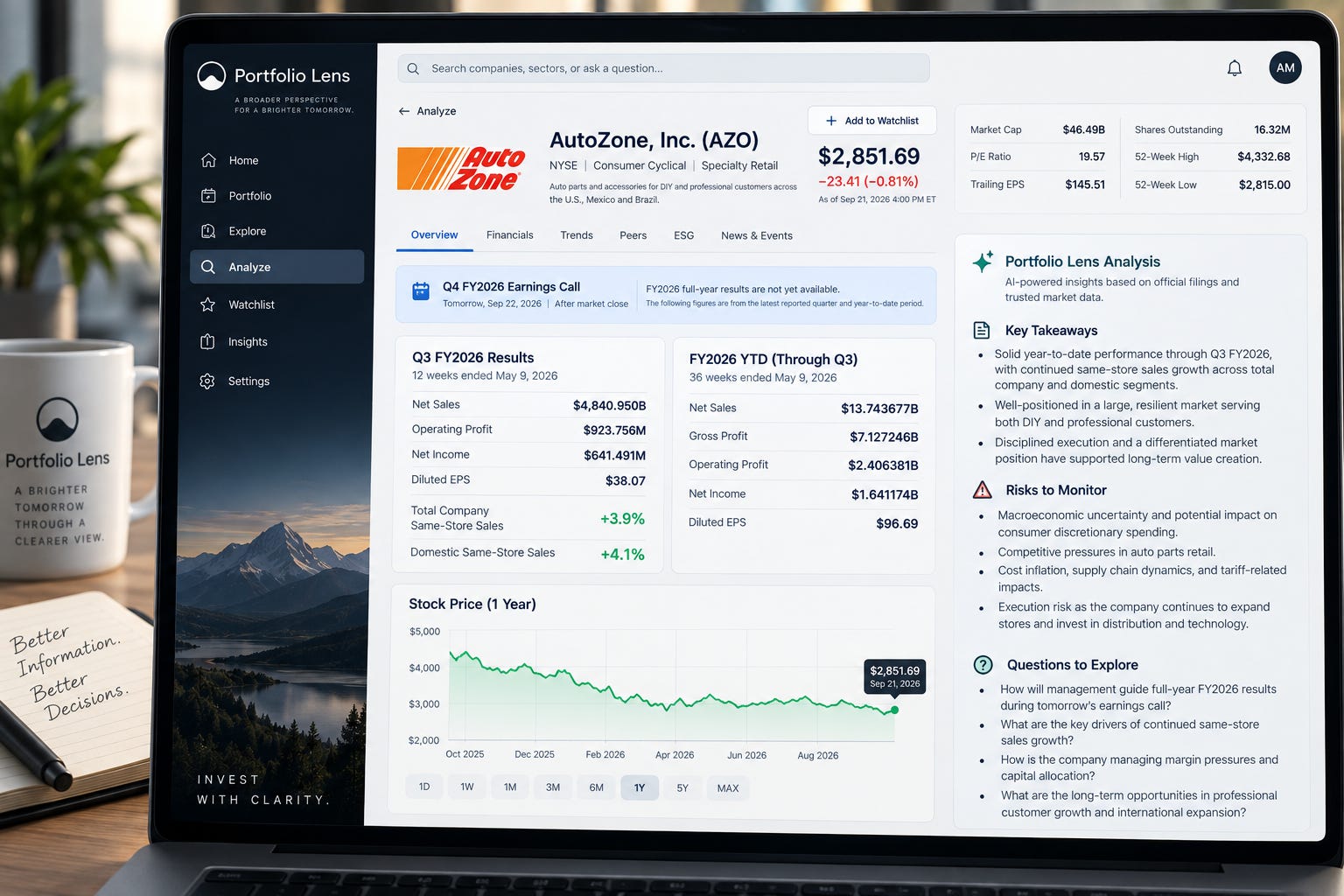
AutoZone posts their year-end numbers Tuesday before the market opens. There are reasons to be optimistic about AutoZone. As with any company, there are reasons to be optimistic, and there are reasons to be concerned. In this post, we will look at:
what would have to happen for the bull case scenario to come true
what we would worry about with the bear case
why this event matters
Bull Case
For the bull case to come true, commercial same-store sales need to accelerate to 11% or higher, and global store openings need to reach 165 or more. That would lift Q4 FY 2026 diluted earnings per share to at least $54 on net sales of 6.75 billion or more.
Total net sales for Q4 FY2026 at or above $6.75 billion
Domestic commercial (DIFM) same-store sales growth for Q4 FY2026 at or above 11.0%
Diluted earnings per share for Q4 FY2026 at or above $54.00
Global net new store openings for Q4 FY2026 at or above 165 stores, bringing full-year FY2026 openings to 370 stores or more
Bear Case
What would bring the bear case into effect would be DIY transaction volumes declining as ticket inflation cools, while commercial comp growth slips below 8%, holding Q4 FY 2026 diluted EPS at or below $51 on total sales of 6.55 billion or less.
Total net sales for Q4 FY2026 at or below $6.55 billion
Total domestic same-store sales growth for Q4 FY2026 at or below 3.0%
Domestic commercial (DIFM) same-store sales growth for Q4 FY2026 at or below 8.0%
Diluted earnings per share for Q4 FY2026 at or below $51.00
Global net new store openings for Q4 FY2026 at or below 145 stores, resulting in full-year FY2026 openings at or below 350 stores
Why this Event Matters
The September 22, 2026 earnings release closes out fiscal 2026 and directly settles three major operational commitments that management established across preceding quarters:
1. Delivery on the Back-Loaded Store and Mega Hub Expansion Target
Throughout fiscal 2026, AutoZone progressively raised its global expansion target from an initial 325–350 stores [transcript:FY2025-Q4] to approximately 365 stores by the end of Q3 [transcript:FY2026-Q3]. Because store openings were heavily skewed toward the back half of the fiscal year, management committed to opening approximately 160 stores globally in Q4 alone (compared to 141 in Q4 of fiscal 2025), alongside 15 Mega Hubs to reach 38 Mega Hub openings for the full year [transcript:FY2026-Q3]. This release provides the final accounting of whether the company achieved this aggressive building cadence within its roughly $1.6 billion capital expenditure plan [transcript:FY2026-Q3], and whether operating expenses per store remained disciplined in the guided ~3% growth range despite the heavy front-loaded occupancy and payroll costs of rapid openings [transcript:FY2026-Q3].
2. Resolution of the Tariff-Driven LIFO Drag on Margins
Tariff-driven inflation created substantial non-cash LIFO headwinds throughout fiscal 2026, reducing operating profit and gross margins by $98 million in Q1 [transcript:FY2026-Q1], $59 million in Q2 [transcript:FY2026-Q2], and $20 million in Q3 [transcript:FY2026-Q3], accumulating to $177 million year-to-date [transcript:FY2026-Q3]. For Q4, management forecasted the LIFO charge to settle at approximately $30 million—a 45-basis-point gross margin headwind and a $1.40 per share drag—bringing full-year LIFO charges to approximately $207 million compared to $64 million in fiscal 2025 [transcript:FY2026-Q3]. The Q4 release settles whether cost layer inflation has indeed plateaued at this lower rate, enabling reported operating profit (EBIT) and diluted EPS ($38.07 in Q3 [transcript:FY2026-Q3, financials:FY2026-Q3]) to re-converge with underlying merchandise margin gains.
3. DIY Traffic Elasticity as Ticket Growth Moderates
In domestic DIY, AutoZone relied on average ticket inflation—which reached 5.6% in Q3 on same-SKU inflation exceeding 7%—to offset consistent negative customer transaction counts of -3.6% in both Q2 and Q3 [transcript:FY2026-Q2, transcript:FY2026-Q3]. Management specifically asserted that average ticket growth would decelerate to the mid-4% range during Q4 as the company laps the onset of prior-year price increases, which should ease pressure on DIY transaction counts by late summer [transcript:FY2026-Q2, transcript:FY2026-Q3]. Q4 tests whether DIY transaction traffic stabilizes as ticket inflation cools, and whether domestic commercial (DIFM) same-store sales can maintain double-digit momentum (comping +10.4% in Q3 [transcript:FY2026-Q3]) against tougher prior-year comparisons.