

October 13, 2026 | Portfolio Lens Research
There is an old temptation in American economic life to confuse the fortunes of Wall Street with those of the nation. When banks prosper, we assume the economy is healthy. When their earnings falter, we anticipate trouble. The relationship is more complicated. Banks do not merely reflect economic conditions. They also profit from uncertainty, market volatility, and the changing price of money.
JPMorgan Chase and Bank of America offer a useful illustration as they prepare to release their latest quarterly filings this week. Together, they oversee trillions of dollars in assets, serve millions of households and businesses, and occupy commanding positions in American finance. Their recent quarterly filings reveal two exceptionally profitable institutions. Yet their sources of growth, their exposure to economic change, and their expectations for the future differ in important ways.
The distinction matters. JPMorgan is demonstrating the extraordinary earning power of American financial markets. Bank of America is demonstrating the enduring profitability of traditional banking. Both suggest that the American economy remains stronger than many pessimists anticipated. Neither provides grounds for complacency.
JPMorgan: The Virtues and Dangers of Extraordinary Success
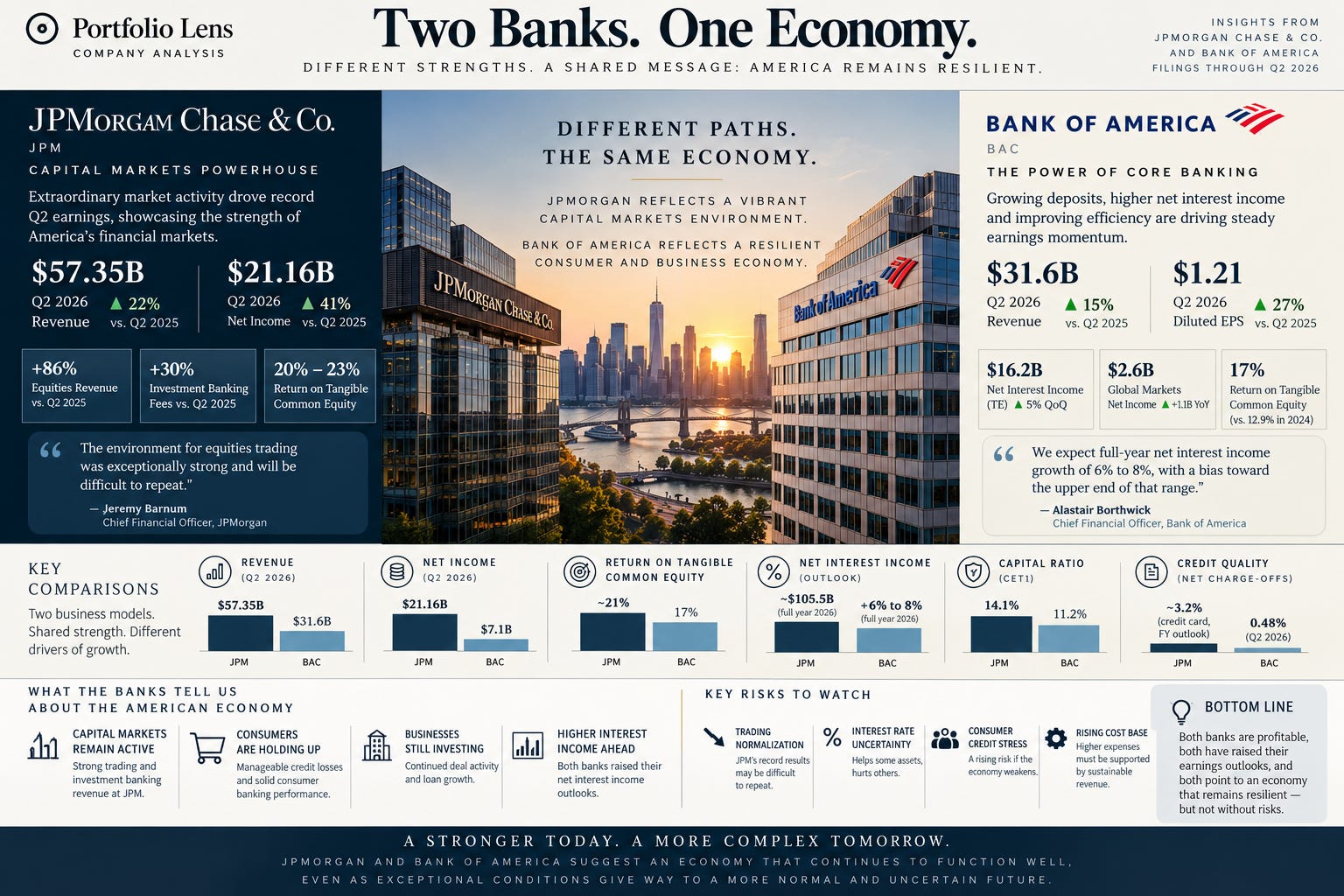
JPMorgan Chase’s second quarter of 2026 was remarkable by almost any measure. Revenue reached $57.35 billion, while net income climbed to $21.16 billion, producing diluted earnings of $7.70 per share. Net income increased 28.3% from the preceding quarter and 41.2% from a year earlier.
Behind these impressive figures was an extraordinary performance in capital markets. Equities revenue surged 86% from the previous year, while investment banking fees increased 30%.
Such results demonstrate the advantages of scale, technology, and deep relationships with institutional clients. JPMorgan has built a financial enterprise capable of earning substantial profits across economic conditions. Its return on tangible common equity, a measure of profitability relative to shareholder capital, has remained between 20% and 23%.
But extraordinary results invite an ordinary question: Can they continue?
JPMorgan’s own management has reason for caution. Chief Financial Officer Jeremy Barnum acknowledged that the exceptional equities trading environment would be difficult to repeat. This observation deserves more attention than another quarter of record earnings.
The bank raised its full-year net interest income forecast to approximately $105.5 billion. It also increased its expense forecast by $2.5 billion to $107.5 billion.
Herein lies the difficulty. Revenue from trading can disappear quickly. The employees, technology, and infrastructure required to generate that revenue are considerably less flexible.
JPMorgan must now demonstrate that its growing expense base can be supported by ordinary economic activity, rather than exceptional market conditions.
At Portfolio Lens, we’ve identified precisely this concern. While we’re overall bullish, we recognizing JPMorgan enjoyed competitive advantages and exceptional returns on capital. Yet the unusually strong trading results can conceal the danger of costs that remain high when revenues return to normal. The disagreement is not about JPMorgan’s quality. It concerns the durability of its recent performance. That is a distinction investors would do well to preserve.
Bank of America: The Quiet Power of Compound Interest
Bank of America presents a different picture.
Its second-quarter revenue reached $31.6 billion, an increase of 15% from the previous year. Diluted earnings rose to $1.21 per share. Return on tangible common equity reached 17%, compared with 12.94% in 2024.
Its Global Markets division performed particularly well. Quarterly net income increased by $1.1 billion from the previous year to $2.6 billion. Consumer Banking earned $3.3 billion, supported by higher revenue and lower credit provisions.
Yet the most important development may be occurring far from the trading floor.
Bank of America holds more than $2 trillion in deposits. It also owns substantial portfolios of mortgage-backed securities and loans purchased when interest rates were lower.
Each quarter, approximately $12 billion to $15 billion of these assets mature. Management expects to replace them with investments yielding 150 to 200 basis points more.
This process provides a relatively predictable source of additional interest income, assuming the expected yield advantage persists.
The results are becoming visible. Quarterly net interest income, measured on a fully taxable-equivalent basis, increased from $15.4 billion in the third quarter of 2025 to $16.2 billion in the second quarter of 2026.
Management has consequently raised its full-year net interest income growth forecast to 6%–8%, with expectations toward the upper end of that range.
Bank of America’s strength is not without qualifications.
Its latest filings show that Business Lending revenue declined $141 million from the previous year, despite higher average loan balances. Lower interest rates reduced the income earned from those loans.
Investment and brokerage revenue growth also slowed in the earlier quarterly comparison, partly because of lower pricing on assets under management.
These developments illustrate a fundamental truth about banking: Lower interest rates can benefit one portion of the balance sheet while harming another.
At Portfolio Lens, we are bullish about Bank of America. From it’s deposit base, improving efficiency, and the continuing replacement of low-yielding assets.
The neutral council perspective offers an important qualification. Recent earnings growth may reflect favorable conditions that cannot persist indefinitely. Higher expectations leave less room for disappointment.
Bank of America may have a more predictable source of earnings growth than JPMorgan’s exceptional trading performance. Predictability, however, should never be confused with certainty.
Two Banks, Two Different Economic Stories
The comparison becomes especially revealing when viewed through the condition of the American economy.
JPMorgan’s strength reflects vigorous capital markets, active institutional investors, and continued demand for financial services. Its rising investment banking fees suggest that businesses remain willing to undertake transactions and commit capital.
Bank of America’s results tell a somewhat different story.
Its growing loan balances, substantial deposits, and improving consumer banking profits suggest that households and businesses continue to participate actively in the economy. Credit losses remain manageable. Its second-quarter consumer banking earnings benefited from a lower provision for credit losses.
Neither institution appears to be reporting the widespread financial deterioration normally associated with a severe recession.
Indeed, both banks have become more optimistic about their own interest income. JPMorgan raised its full-year forecast, while Bank of America increased its expected growth rate.
These revisions do not constitute explicit forecasts of accelerating economic growth. They do, however, indicate confidence in the banks’ ability to earn substantial income from their existing balance sheets.
There is an important distinction between a bank expecting higher profits and a bank expecting a stronger economy.
JPMorgan can prosper when markets are volatile. Bank of America can benefit when older assets mature and are replaced at higher yields. Neither development necessarily requires rapid economic expansion.
The evidence therefore supports a more restrained conclusion: America’s financial system remains profitable, its consumers have not suffered a broad collapse in credit quality, and its largest banks continue to invest for growth.
That is encouraging. It is not a guarantee of prosperity.
The Risks Beneath the Prosperity
Both banks face constraints that deserve attention.
JPMorgan’s standardized Common Equity Tier 1 capital ratio declined to 14.1% in the second quarter as risk-weighted assets expanded. This ratio measures an important part of the capital available to absorb losses.
The bank remains strongly capitalized, but continued balance sheet expansion requires additional capital. Its size, which provides substantial competitive advantages, also subjects it to demanding regulatory requirements.
Bank of America’s corresponding capital ratio stood at 11.2%. Its council regards that position as sufficient to support continued dividends, share repurchases, and measured growth.
The two ratios should not be compared without considering each institution’s regulatory requirements and risk profile.
More revealing is the question of credit quality.
JPMorgan lowered its expected full-year credit card net charge-off rate to approximately 3.2%, reflecting favorable delinquency trends. Bank of America’s recent quarterly net charge-off ratio has remained near 48 basis points.
These measures cover different lending exposures and are not directly comparable. Yet both suggest that credit deterioration remains contained.
This matters enormously.
American households can tolerate higher borrowing costs for a considerable period. They cannot indefinitely tolerate falling income, rising unemployment, and growing debt obligations.
Should consumer credit losses accelerate, the consequences would extend well beyond bank earnings. They would indicate that financial pressure was reaching the households whose spending supports much of the American economy.
For now, the banks’ reported credit experience provides more evidence of resilience than distress.
What We See — What We Question
Perhaps the most instructive finding from the Portfolio Lens analysis is the similarity between the two. we are bullish on both. Recognizing institutions that generate returns substantially above their estimated cost of capital. Both firms enjoy the advantages of scale, established customer relationships, and substantial financial resources.
And both face the same underlying danger: Recent success may create expectations that ordinary economic conditions cannot satisfy.
For JPMorgan, the central question is whether exceptional capital markets revenue can support a higher expense base.
For Bank of America, the question is whether improving net interest income and operating efficiency can continue as interest rates and economic conditions change.
The councils therefore distinguish between the quality of a business and the attractiveness of its immediate prospects.
JPMorgan possesses formidable competitive advantages. Its scale and institutional relationships are difficult to reproduce. But its extraordinary second-quarter performance may prove difficult to repeat.
Bank of America benefits from a substantial deposit franchise and a favorable asset-reinvestment cycle. Yet its projected improvement depends partly on future interest rates, deposit behavior, and management’s ability to control expenses.
However, it’s always worth reminding investors that excellent businesses can disappoint when expectations become excessive.
The greatest danger may not be that these banks perform poorly. It may be that they perform well, but less spectacularly than investors have come to expect.
What Comes Next for the American Economy?
The coming quarters will provide an important test.
We at Portfolio Lens have established measurable conditions for evaluating each institution’s third-quarter performance.
For JPMorgan, a particularly favorable result would include quarterly revenue of at least $51 billion, net income of at least $16 billion, and continued support for its $105.5 billion annual net interest income forecast.
For Bank of America, favorable results would include quarterly net interest income of at least $16.4 billion, revenue of at least $31 billion, and an efficiency ratio at or below 59%.
These are analytical thresholds, not management promises or forecasts of what will occur.
The broader economic question is whether consumers continue to repay their debts, businesses continue to borrow and invest, and financial markets remain sufficiently active to support the banks’ earnings.
A deterioration in credit quality would be more troubling than a temporary decline in trading revenue. The former would suggest weakness in the economy. The latter might merely indicate a return to ordinary market conditions.
This distinction should guide any interpretation of the next earnings reports.
The Verdict: Resilience Without Complacency
America’s two banking giants present a portrait of an economy that remains productive, financially active, and remarkably adaptable.
JPMorgan demonstrates the immense advantages enjoyed by institutions that dominate modern capital markets. Bank of America demonstrates the enduring power of deposits, disciplined lending, and the patient reinvestment of financial assets.
Both are profitable. Both have improved their earnings outlooks. Both continue to return substantial capital to shareholders.
But their success does not eliminate the economic cycle.
The more useful conclusion is that the American economy appears to have entered the final months of 2026 with considerable financial strength, even as its largest banks confront the limits of exceptional performance.
JPMorgan must prove that extraordinary earnings can become sustainable earnings. Bank of America must prove that its favorable balance sheet dynamics can continue to generate growth.
For investors, the distinction is consequential. For the American economy, the message is cautiously encouraging.
The banks are not signaling an approaching economic collapse. They are signaling an economy that continues to function well, while reminding us that prosperity and permanence are two very different things.
And that, perhaps, is the most useful lesson of all.