

Prefer to watch? Here’s the 4-minute summary:
November 4, 2026
Consumer is still spending, though apparently with less enthusiasm for crossing borders. Meanwhile, Americans are buying more prescription drugs, even as pharmaceutical companies collect less per dose. These are not contradictions. They are reminders that corporate revenue, consumer demand and profitability are 3 different things—an observation that Wall Street occasionally treats as a discovery.
Before Visa, Mastercard, Eli Lilly and Merck reported, we published 17 financial thresholds on October 27 and 28. The results are now in: 11 Bull, 3 Neutral, and 3 Bear. The payment networks delivered strong earnings but less impressive transaction growth. The Jevons Paradox appears again. The drugmakers showed that falling prices need not mean falling revenue: Lilly sold 53% more medicine at prices 15% lower.
How We Keep Score
Our lines were published before earnings, not reconstructed afterward. Results meeting or exceeding the strong line earn Bull; those reaching the weak line earn Bear; everything between is Neutral. Undisclosed measures remain ungraded. We compare results with company releases and SEC filings, not Wall Street estimates.
The purpose is not to prove we can see the future. It’s to prevent rewriting the past.
Visa: Profits Outrun Revenue
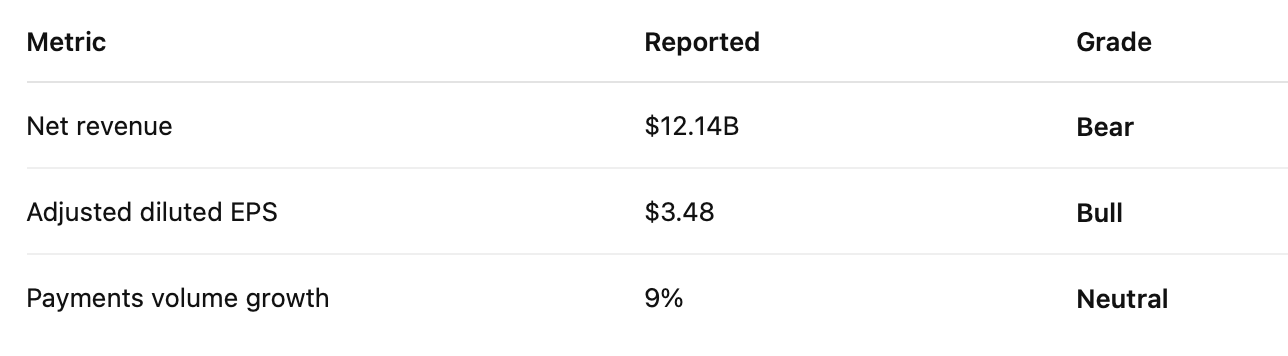
Visa’s revenue increased 13%, but its $12.14 billion result missed our $12.20 billion weak line. Client incentives—the payments Visa makes to banks issuing its cards—rose 21%, faster than the preceding quarter’s 18%. Yet adjusted earnings climbed 17% to $3.48 per share, clearing our $3.45 Bull threshold.
Payments volume grew 9% in constant dollars, between our 8% Bear and 10% Bull lines. Consumers are still spending. Whether they are buying more goods or merely paying higher prices is another question.
Visa: One Bull, one Neutral, one Bear.
Mastercard: Strong Earnings, Slower Travel
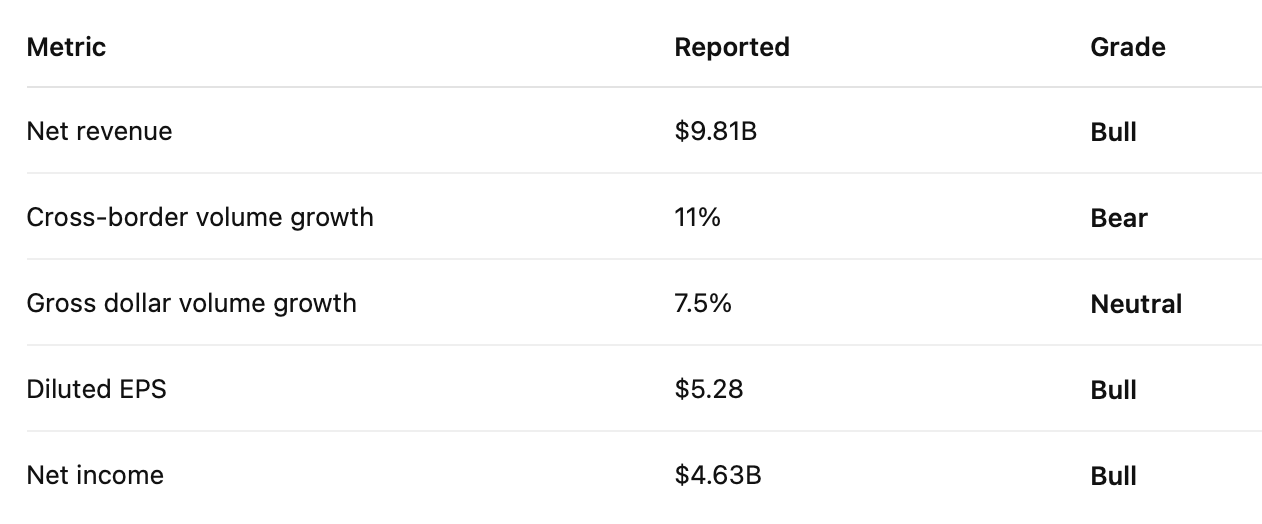
Mastercard’s revenue increased 14% to $9.807 billion, narrowly exceeding our $9.80 billion Bull threshold. Earnings per share rose 22%, while net income increased 18%. Both cleared their strong lines.
Transaction volumes were less encouraging. Gross dollar volume increased 7.5% in local currency, earning Neutral. Cross-border volume grew 11%, exactly our Bear threshold. More revealing is the progression: cross-border growth has slowed for four consecutive quarters, from 15% to 14%, 13%, 12%, and now 11%. The payment networks are prospering. International travel spending is losing momentum. Those statements can both be true.
Mastercard: Three Bulls, one Neutral, one Bear.
Eli Lilly: More Medicine, Lower Prices
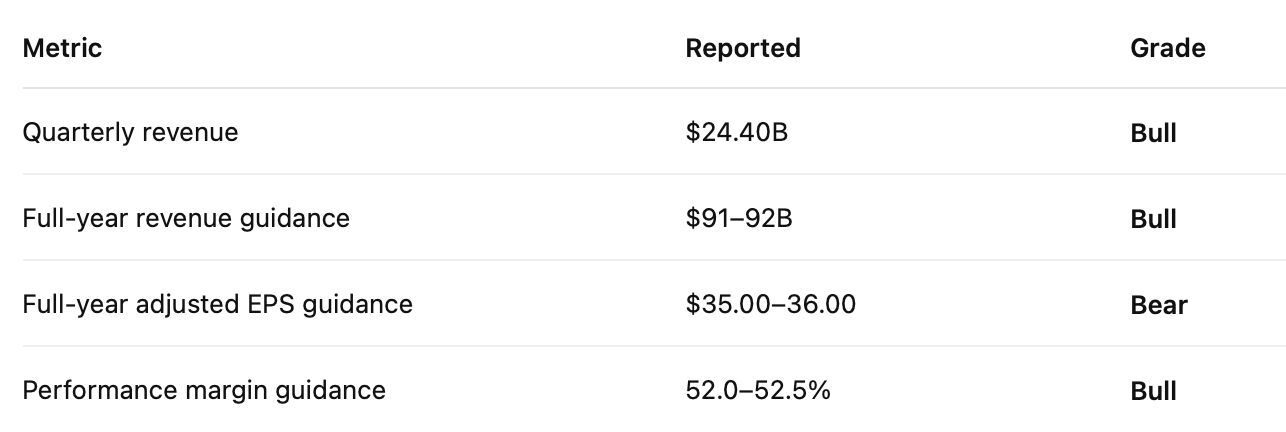
Lilly’s revenue surged 39%, driven by 53% higher volume despite 15% lower realized prices. Mounjaro sales rose 65% to $10.72 billion; Zepbound increased 49% to $5.35 billion. Management raised full-year revenue guidance to $91–92 billion and performance margin guidance to 52.0–52.5%. Both cleared our Bull lines. Yet adjusted EPS guidance fell to $35.00–36.00, triggering Bear. The explanation matters: acquired research and development charges reduced the outlook by $4.57 per share, more than offsetting $4.07 of underlying improvement. The business strengthened. The earnings forecast declined. Our published rules grade the latter Bear, regardless of the explanation.
Eli Lilly: Three Bulls, one Bear.
Merck: Replacing Its Own Blockbuster
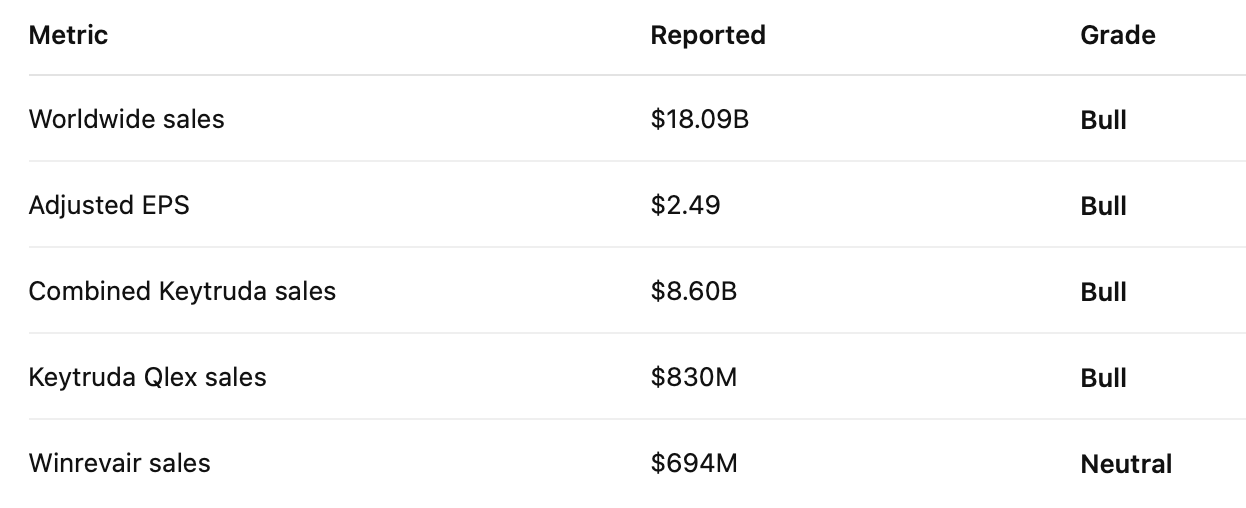
Merck’s revenue increased 5%, while adjusted earnings reached $2.49 per share. Both exceeded our strong lines. The more interesting development occurred inside Keytruda. Intravenous sales declined 5% to $7.77 billion, while the newer under-the-skin Qlex formulation reached $830 million, up from $463 million in the preceding quarter. Combined Keytruda revenue still increased 6%.
Merck is demonstrating an old pharmaceutical strategy: replace your own product before competitors or regulators diminish its value. Winrevair nearly doubled to $694 million, just $6 million below our Bull threshold. Close is not the same as passing.
Merck: Four Bulls, one Neutral.
The Scorecard
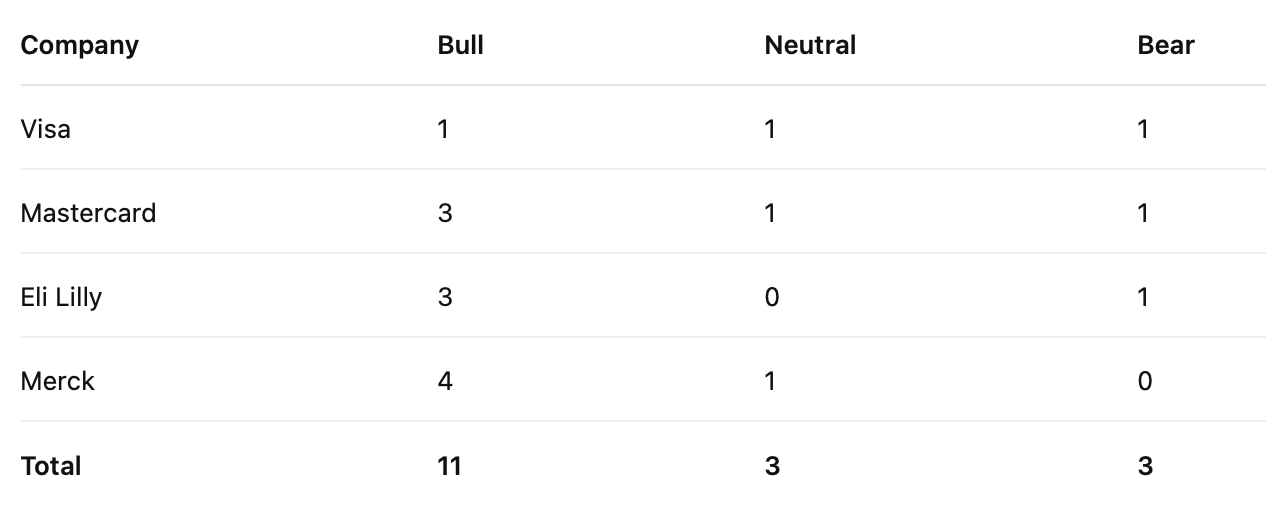
Running record: 69 published thresholds, 67 graded: 40 Bull, 19 Neutral, eight Bear, with two remaining ungraded.
What the Results Tell Us
The payment networks show continued spending growth but weakening cross-border momentum. The drugmakers show that volume growth can overcome price pressure, although acquisitions and product transitions complicate the earnings picture.
We will watch Visa’s rising client incentives, Mastercard’s international volumes, Lilly’s acquisition charges, and Merck’s conversion from intravenous Keytruda to Qlex.
Seventeen thresholds were published before the results. Three reached our weak lines. They remain on the record.
Thresholds first. Grades later. Misses included.
Subscribe to Portfolio Lens Research for our next scorecard, covering Apple and AMD on Thursday.
Sources: Visa fiscal Q4 2026 earnings release (8-K Ex. 99.1, Oct 27, 2026) · Mastercard Q3 2026 earnings release (8-K Ex. 99.1, Oct 29, 2026) · Eli Lilly Q3 2026 earnings release (8-K Ex. 99.1, Oct 29, 2026) · Merck Q3 2026 earnings release (8-K Ex. 99.1, Oct 29, 2026)
For informational purposes only. Not investment advice.