

Prefer to watch a 2 minute visualization?
November 19, 2026
The American homeowner has developed a relationship with procrastination. The kitchen needs remodeling, the roof needs replacing and the bathroom has needed renovation since the last administration. But mortgage rates have made moving unattractive, construction costs have made renovating prohibitive and the prudent homeowner has discovered that a perfectly respectable plan is to do nothing. This presents a problem for Home Depot and Lowe’s, whose prosperity depends on Americans eventually deciding that something must be done.
This quarter, both companies found a way to sell more, with customers visiting less. While transactions declined, the average receipts increased and sales exceeded our expectations. Unfortunately, a larger receipt is not necessarily a healthier business. It might just mean lumber, electrical cable and diesel have become more expensive. Both retailers now expect to retain less of each sales dollar, even as their revenue forecasts improve. Lowe’s received a welcome contribution from tariff refunds while Home Depot prepares to change chief executives. The question is no longer whether Americans are spending more at home improvement stores. They are. The question is whether the stores are making more money from their spending. On November 16, 2026 we published our lines about Home Depot and Lowes, now we’ll review them.
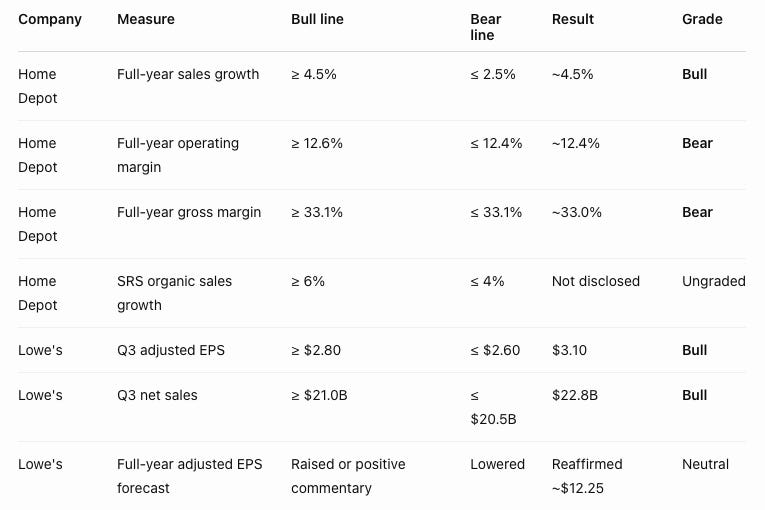
Combined result: 3 Bull, 1 Neutral, 2 Bear and 1 Ungraded.
Home Depot’s sales forecast landed precisely on our Bull threshold while operating margin landed on our Bear threshold. Both grades stand. Its SRS business offered only a qualitative outlook, so that measure remains ungraded. Lowe’s reaffirmed its earnings forecast, earning a Neutral. A scorecard that changes its rules after the results is not analysis. It is autobiography.
Home Depot: More Revenue, Less Profitability
Home Depot’s third-quarter revenue increased 4.9% to $43.4 billion. Comparable sales rose 2.2%, but transactions declined 0.5% while average spending increased 3.0%. Management attributed approximately half that ticket increase to higher prices on comparable merchandise. Transactions exceeding $1,000 rose 4.5%, suggesting some larger projects are returning.
The less encouraging figure was gross margin, which declined approximately 60 basis points to 32.8%. Management cited rising costs and a changing product mix following acquisitions.
For the full year, Home Depot expects sales growth of approximately 4.5%, reaching the upper end of its previous guidance. The acquisition of GMS contributes to that expansion. Yet the company reduced its gross margin outlook to approximately 33.0% and operating margin to 12.4%, both weak under our published thresholds.
The professional roofing and building-products business, SRS, expects only low single-digit organic growth. Finance chief Richard McPhail cited two relatively quiet storm seasons, an unfortunate development for a roofing distributor. More consequential is the housing market. McPhail observed that housing turnover has scarcely moved in four years.
Home Depot’s customers are maintaining their homes, but many are postponing the expensive projects that make its economics particularly attractive.
The company now approaches a leadership transition. McPhail will succeed Ted Decker as chief executive, inheriting a retailer with expanding revenue and narrowing margins. The former is pleasant to announce. The latter is considerably harder to reverse.
Lowe’s: A Good Quarter With an Unusual Benefactor
Lowe’s reported $22.8 billion in sales, up from $20.8 billion, with comparable sales growth of 1.8%. Transactions declined 1.7% while average spending increased 3.5%. Higher prices for lumber and electrical cable contributed to the larger receipts.
Acquisitions of FBM and ADG also expanded reported sales, although Lowe’s did not separately quantify their contributions.
Adjusted earnings reached $3.10 per share, comfortably above our Bull threshold of $2.80. But the result included 34 cents per share from tariff refunds. Lowe’s spent approximately one-third of that benefit on lower prices.
The margin picture is less flattering. Gross margin declined 124 basis points despite approximately 120 basis points of assistance from tariff refunds. Without that benefit, the deterioration would have been substantially greater. Management cited acquisition-related mix, appliances and fuel costs. Finance chief Brandon Sink noted diesel prices near $6.
Lowe’s raised its annual sales outlook from $92.0 billion to $92.5 billion but reduced its adjusted operating margin forecast from 11.6% to 11.5%. Its full-year adjusted earnings forecast remained approximately $12.25 per share, producing our Neutral grade.
Chief executive Marvin Ellison highlighted the strongest appliance comparable-sales performance in five years. He was less enthusiastic about residential construction, describing single-family building conditions as exceptionally difficult.
The message resembles Home Depot’s: customers are spending more per visit, but that does not mean they are undertaking more projects.
The Trouble With Bigger Receipts
Both companies exceeded our strongest sales lines and improved their revenue forecasts. However, neither demonstrated that customers are visiting more often. Acquisitions contributed to growth, inflation enlarged receipts and tariff refunds supported Lowe’s earnings.
These are legitimate financial results, but they are not interchangeable with stronger underlying demand. The housing market remains the central obstacle. Homeowners reluctant to surrender low mortgage rates are reluctant to move. Builders facing expensive financing are reluctant to build. And consumers confronting higher material costs are increasingly selective about renovations.
For Home Depot and Lowe’s, that leaves an uncomfortable math problem. Revenue can increase because prices rise, but profitability depends on how much of those higher prices survives the costs of acquiring, transporting and selling the merchandise. Both retailers have demonstrated that they can generate bigger sales numbers in a difficult housing market. They have yet to demonstrate that bigger sales will produce better margins.
Sources: Home Depot third-quarter fiscal 2026 earnings release, Form 8-K and earnings call, November 17, 2026; Home Depot second-quarter earnings release, August 18, 2026; Lowe’s third-quarter fiscal 2026 earnings release, Form 8-K and earnings call, November 18, 2026; Lowe’s second-quarter earnings release, August 19, 2026; Portfolio Lens Research, November 16, 2026.
Thresholds first. Grades later. Misses included.
Not investment advice. Research for informational purposes only. Investing involves risk, including loss of principal. Past performance does not indicate future results.